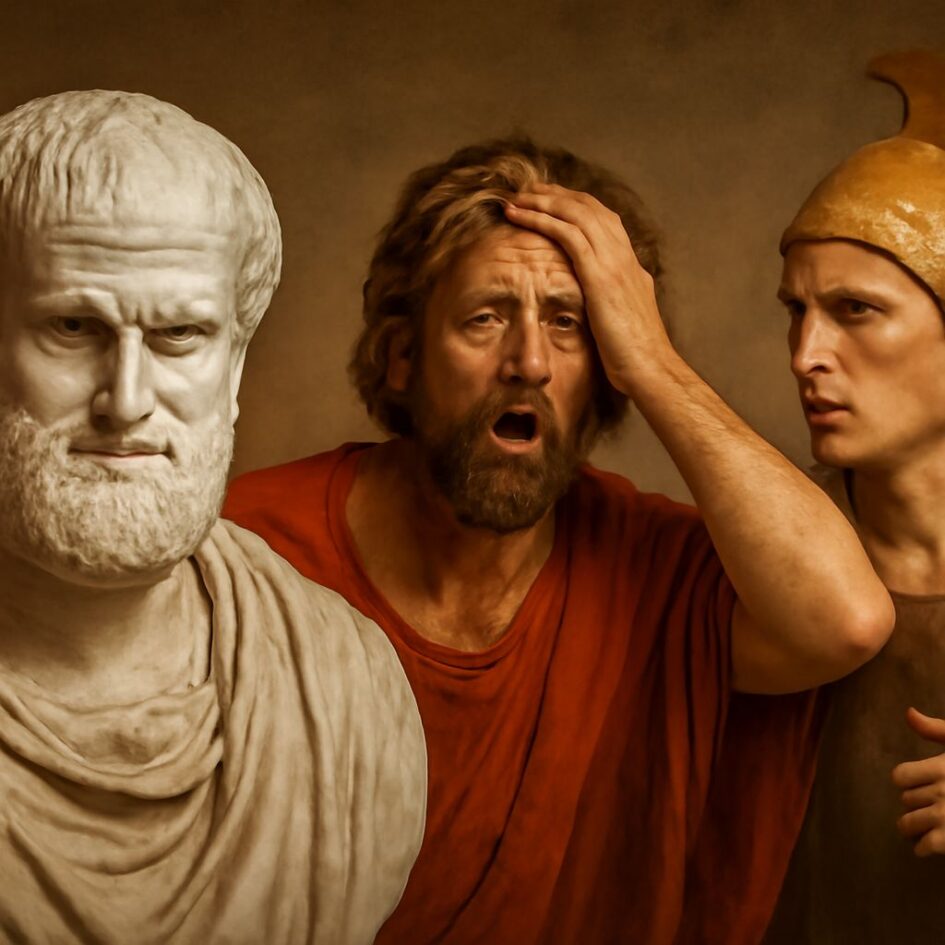
Does Aristotle define a tragic hero as a good person destroyed by one fatal personality defect? His account in the Poetics is more complicated. He discusses a figure whose change from prosperity to misfortune arises through hamartia, a Greek word translated in several ways, including error and flaw. The nature of that error remains a subject of interpretation.
The qualities associated with a tragic protagonist matter because Aristotle is interested in the effect of an entire action on an audience. A character’s choices, the information available at the time, and the way events unfold all contribute to pity and fear. Reducing a play to one defective trait can conceal the very choices and discoveries that make it tragic.
Qualities of a Tragic Hero in the Poetics
In chapter 13, Aristotle considers the kind of plot he judges particularly effective. His preferred figure is neither outstandingly virtuous nor thoroughly wicked and moves from good fortune to bad through a significant hamartia, rather than sheer vice. He also refers to people of prominence. The University of Hawaiʻi’s guide to the chapter explains how these criteria relate to the audience’s response.
For Aristotle, a definition of a tragic hero follows from his account of action and its effects. This describes a preferred tragic plot and protagonist, not a universal checklist for every serious story. Aristotle’s definition of a tragic hero is a convenient modern shorthand for that discussion, but he is analyzing how dramatic actions are constructed. His focus on fortune, character, and response is tied to the plays and dramatic conventions he examines.
For a tragic hero, Aristotle favors a position between extremes partly because the fall should be moving rather than simply satisfying as punishment. A villain receiving a deserved penalty may produce a different response from a person whose suffering seems out of proportion to an error. Pity and fear are connected to that difference: audiences see both vulnerability and a person close enough to themselves to make the danger intelligible.
The Poetics also gives plot priority over character. In Aristotle, tragic hero status depends on the relationship between action and outcome. Events are not a display case for a list of traits; they have a sequence and consequences. A reader who asks what the protagonist does, what follows, and when information becomes available is closer to Aristotle’s inquiry than one who attaches a label and stops there.
Error, Flaw, or Something Between?
The translation of hamartia changes the question a reader asks. “Flaw” can suggest a stable defect of personality. “Error” can point to an action or judgment made with incomplete knowledge. The S. H. Butcher translation offers “error or frailty,” while an excerpt from classicist Ruth Scodel’s introduction to Greek tragedy uses “mistake” and warns against an automatic search for a protagonist’s faults.
Those choices should not be flattened into a new rule that the term can only mean an innocent mistake. Classicist T. C. W. Stinton argues for a range extending from ignorance of fact to moral error; his scholarly article challenges a reading that restricts the word to factual mistakes alone. The debate concerns how a Greek term functions in its context, not merely which English synonym sounds best.
The practical difference is substantial. If a person acts without knowing a crucial relationship, the tragedy may depend on the gap between intention and consequence. If a choice grows out of pride or rigidity, the audience may reasonably examine responsibility. Either way, a reader must show how the action contributes to the outcome. Naming a flaw is the beginning of an argument, not the evidence for it.
Plot Elements and Modern Checklists
Modern summaries often list the elements of a tragic hero as elevated status, a flaw, a reversal, and a moment of recognition. Such lists collect useful concepts, but they can blur a distinction: reversal and recognition are features of plotted action, not personality traits. Aristotle’s discussion of complex plots in the Poetics treats a reversal as a change in the direction of events and recognition as a movement from ignorance to knowledge.
In a well-connected plot, discovery can change the meaning of what came before. A messenger who expects to bring relief may reveal information that makes a situation worse. Recognition does not always need to happen in the same form or at the same moment as reversal, but looking for their relationship helps explain how an audience’s understanding changes.
Pity and fear are responses to the action, while catharsis names an effect associated with those emotions in Aristotle’s account of tragedy. Translators and scholars debate how best to understand that term, often rendered as purification or purgation. It should not be treated as a promise that every viewer leaves a performance emotionally cured.
The qualities of a tragic hero emerge through action: a list of tragic hero qualities can organize an essay if each item is tested against specific scenes. Does status matter to the consequences? What exactly does the character know before acting? Does recognition alter the outcome or only the character’s understanding? Those questions turn a checklist into an interpretation that another reader can examine.
Oedipus: Knowledge Arrives Too Late
In Sophocles’ Oedipus the King, Oedipus seeks the cause of a plague in Thebes and vows to find the killer of the former king. His investigation reveals that he himself killed his father and married his mother without knowing who they were. The search for a remedy leads to the discovery that destroys his understanding of his own life. Aristotle discusses the play when explaining recognition and reversal.
One reading treats Oedipus’s confidence and anger as traits relevant to his acts. Another gives greater weight to ignorance, prophecy, and the painful consequences of knowledge. Scodel warns that forcing the play into a simple lesson about a personal fault can diminish its tragedy. Both approaches must reckon with the actions onstage: Oedipus pursues the truth even as witnesses try to prevent its disclosure.
The characteristics of a tragic hero become more precise here when tied to events. Oedipus is a ruler, but his position matters because the investigation concerns the welfare of the city as well as his household. His discovery is a change in knowledge; the suffering that follows cannot be explained adequately by saying he was merely proud.
Antigone and Creon: A Test of the Formula
Sophocles’ Antigone makes the limits of a single character formula visible. Antigone defies Creon’s order by burying her brother; Creon insists on enforcing the order and eventually attempts to reverse course too late. A reading centered on Creon can emphasize his inflexibility and delayed recognition. A reading centered on Antigone must also consider the claims of family duty and the justice she believes requires burial.
Scodel argues that Creon fits Aristotle’s pattern more readily, while forcing the whole play into that pattern can distort Antigone’s role. Her comparison is a reminder that identifying Aristotle’s tragic hero in one play is an interpretation, not a mechanical classification. Different protagonists can bring different moral conflicts into view.
The modern phrase “tragic flaw” can illuminate a play when a critic connects a trait to decisions and consequences. It becomes less persuasive when it replaces the conflict among law, duty, knowledge, and power with a diagnosis. These tragedies remain open to competing readings because their characters’ actions confront limits that no single adjective can explain.