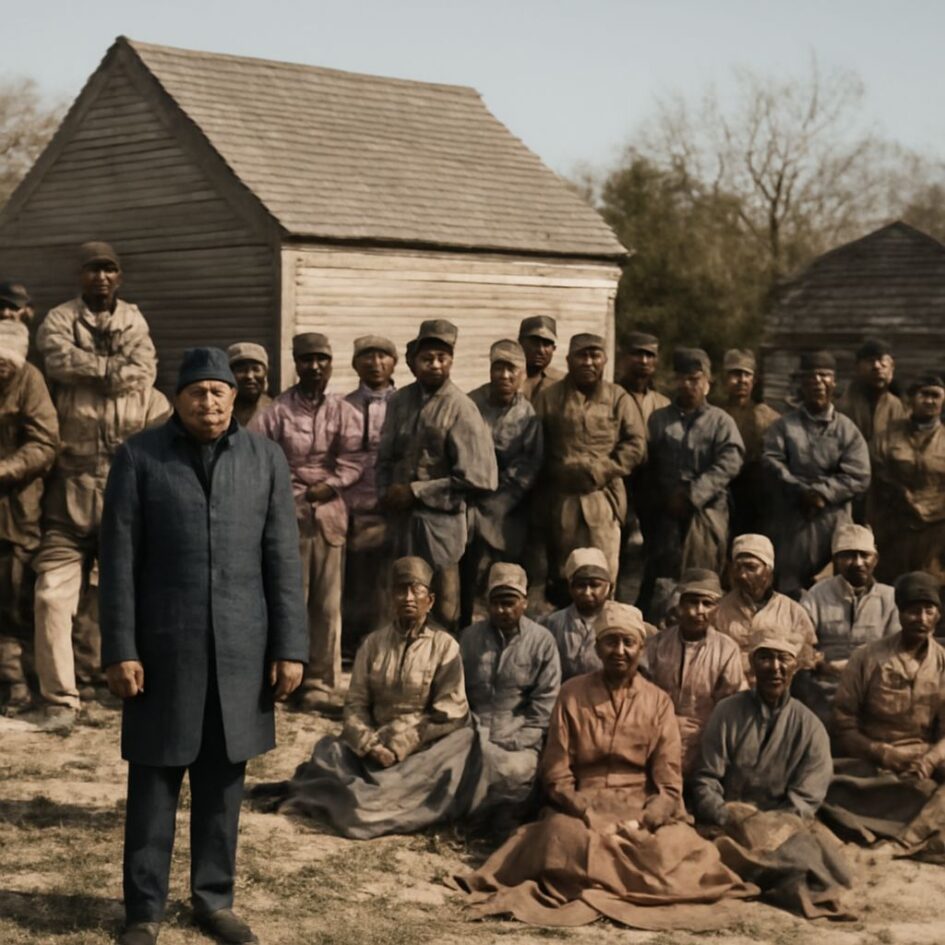
The idea that one people invented slavery at a known moment does not fit the surviving evidence. Forms of enslavement existed in several ancient societies, and their rules and practices differed. Asking who first began enslaving others raises a question older than the records historians can confidently trace to a single origin.
The history of human enslavement also extends beyond the history of the United States. Ancient laws, African societies, Atlantic trade, and American plantation systems belong to connected but distinct stories. Comparing their dates and institutions shows how control over people was established, justified, resisted, and sometimes passed from one generation to the next.
History of slavery: what the records can tell us
Slavery involved a person being held under another’s control and deprived of freedom, often with law or custom treating that person as property. The precise rules varied. An enslaved person might be captured in war, born into an enslaved status, or forced into bondage through another process. Laws could differ over sale, inheritance, family relationships, and possible paths to freedom.
Written evidence places slavery in ancient Mesopotamia. Fordham University’s collection of historical sources points to Mesopotamian legal and contract material spanning the third and first millennia BCE, including the laws associated with Hammurabi in the eighteenth century BCE. Such documents show that forms of enslavement existed by those dates. They do not establish the first time any community held another person in bondage.
How did slavery begin? The question has no single documented answer, but historians can examine particular systems. In the Roman world, for example, enslavement and trade in enslaved people were established institutions; war and birth were among the ways people entered enslaved status. Roman law and practice developed in their own setting, centuries before the Atlantic plantation economies of the Americas.
African societies before Atlantic expansion
When did slavery start in Africa? Africa is a continent with many histories, and surviving evidence does not support one starting date for every society. Forms of bondage existed in parts of the continent before Europeans developed the Atlantic trade. The College of Charleston’s historical exhibit describes practices in West and Central Africa before and during that trade.
African slavery was not a single institution. Depending on the place and period, enslaved people could be held for labor in households, agriculture, or other work, and legal status and treatment varied. Some systems allowed forms of incorporation into a household or community; others involved hereditary status and sale. Those differences should be studied through specific evidence, not used to suggest that being held in bondage was harmless. Enslavement meant a loss of control over work and personal life, even where the rules of a particular society differed from those in the Americas. A description of legal status should therefore be accompanied by evidence about what people could actually do and how those with power treated them.
How did slavery start in Africa? The answer must be sought in individual regions and periods rather than in a continental origin story. Captivity in conflict and other forms of coercion appeared in different settings. Enslaved people were also moved through networks across the Sahara, the Red Sea, and the Indian Ocean; an academic review of African slaving and trade places those networks alongside the Atlantic trade.
The Atlantic trade and its transformation of slavery
From the fifteenth century onward, European maritime expansion connected parts of Africa, Europe, and the Americas through a trade in captive people. European traders bought captives from African sellers and also participated in kidnapping and coercion. African rulers, merchants, and intermediaries played roles in supplying captives, while European governments, merchants, shipowners, and plantation owners organized and financed major parts of the Atlantic system.
The Metropolitan Museum of Art’s overview explains that slavery existed in Africa before European contact and that the Atlantic trade changed its development and scale. Colonial demand for labor on plantations encouraged the expansion of trade and reshaped conflicts and political relationships in affected regions. The Met identifies the Asante kingdom on the Gold Coast as a major exporter of captives in the eighteenth century, a specific example of how one African state participated in that wider network. Responsibility cannot be explained by assigning every action to a continent as a whole; it requires identifying the institutions and people involved in particular transactions.
The crossing itself, often called the Middle Passage, forcibly separated people from families and homelands. Those who survived arrived in societies where plantation owners used coerced labor to produce commodities for distant markets. Enslaved Africans and their descendants resisted in many ways, from preserving relationships and cultural practices to escape and organized revolt. Their actions belong to the history of slavery, not merely to its aftermath.
The United States as one part of a wider history
In English Virginia, colonial lawmakers built a system of racialized, hereditary slavery over time. A 1662 law made a child’s status follow the mother’s status. Colonial Williamsburg’s teaching collection identifies that law within a sequence of restrictions. This rule helped make enslavement inheritable across generations, while treating the children of enslaved women as property under colonial law.
The United States prohibited the international importation of enslaved people beginning in 1808. That did not end enslavement or the domestic trade: people continued to be bought, sold, and forcibly moved within the country. The National Archives makes that distinction clear in its account of the law.
The Thirteenth Amendment, ratified in 1865, abolished slavery and involuntary servitude in the United States except as punishment for crime after conviction. It was a crucial change in U.S. law, not a date on which every form of slavery ended everywhere. Different societies abolished legal slavery at different times, and the consequences of enslavement continued after legal abolition.
Why a single origin cannot be named
When was slavery a thing? The surviving record spans ancient societies and later systems across many regions, with major changes over time. A slavery history that begins only with one country misses earlier evidence; one that treats all systems as interchangeable misses their legal and human differences.
Who started slavery in the world? No surviving evidence identifies a single inventor or starting year. The more answerable questions concern a particular society: when its records show enslavement, how people were held or traded, what laws governed their status, and how they resisted.