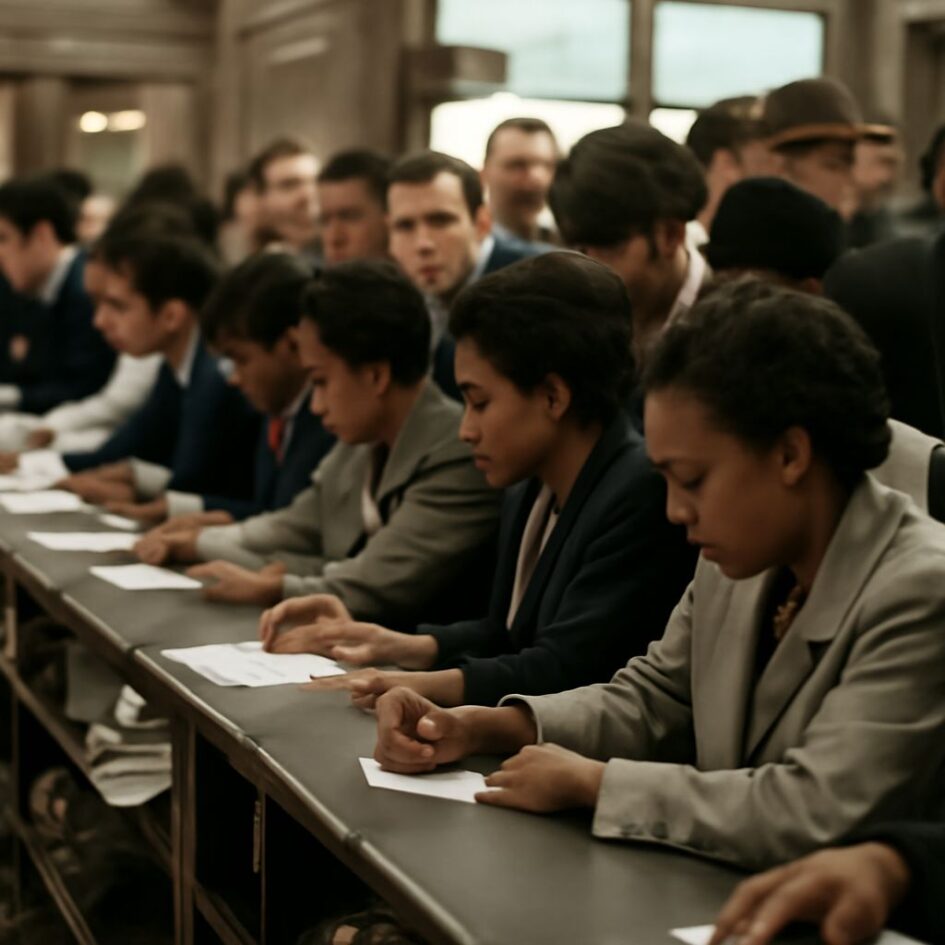
How did a seat at a lunch counter become a challenge to segregation across the South? In 1960, students and community allies used sit-in demonstrations to demand service at businesses that excluded Black customers. Their actions were local and carefully organized, but news, personal networks, and shared meetings carried the idea from one city to another.
The 1960 student protests did not begin the long struggle for equal access to public places. They drew on earlier campaigns and on training in nonviolent action. Their rapid spread brought a new generation of organizers into public view and helped create an organization through which students could continue working together.
1960 sit ins begin a new wave
On February 1, 1960, four Black students from North Carolina Agricultural and Technical College sat at a whites-only Woolworth’s lunch counter in Greensboro. Ezell Blair Jr., David Richmond, Franklin McCain, and Joseph McNeil asked to be served. They remained after service was refused. The next day more students joined them, and the protest continued in the days that followed. The National Park Service account names the four and describes the counter where they took their seats.
The action exposed a contradiction in an ordinary commercial setting: Black customers could spend money in a store yet be denied a place to eat at its counter. A stool, a cup of coffee, and the refusal of service made segregation visible in a place familiar to shoppers. The students’ demand was for equal treatment in a public business, and their continued presence turned that demand into a public event.
The Greensboro sit ins drew attention far beyond one store. Students in other cities read and heard about the demonstration and organized actions of their own. The Smithsonian’s history of SNCC describes the spread across several states during February and the student organizing that followed. News coverage helped make a local confrontation visible to people who could not stand at the counter themselves.
Earlier organizing and other cities
The movement did not emerge from an empty landscape. In Durham, North Carolina, activists had staged a sit-in at the Royal Ice Cream Company in 1957. In Nashville, Tennessee, students had participated in nonviolence workshops led by James Lawson and had tested segregated counters before the Greensboro action. The National Park Service survey places those earlier efforts alongside the 1960 campaign.
Nashville’s campaign grew in February 1960 as students and supporters organized demonstrations at downtown stores. Participants faced hostility, violence, and arrest. Their preparation included thinking through how to remain nonviolent under provocation and how to keep the campaign going when people were taken into custody. A protest at one counter depended on many people beyond those seated there: organizers, supporters, lawyers, and others who sustained the effort.
Rock Hill, South Carolina, provides another example of local initiative. On February 12, approximately 100 Friendship Junior College students began demonstrations at several downtown businesses, according to the National Park Service history of McCrory’s. Stores closed rather than serve the Black demonstrators. The episode connected Rock Hill to the wider wave while reflecting decisions made by students in that city about where and how to act.
The sit ins in these places shared a purpose, but they unfolded under different local conditions. The strength of the movement lay partly in that combination: a recognizable method could be adapted to a city’s businesses, organizations, and political pressures. High school students as well as college students participated in some communities, and older residents supplied support through churches and civic networks.
Training, arrests, and public attention
Nonviolent direct action required preparation. Participants planned where to go, how to respond to abuse, and what to do if police arrested them. A person seated at a counter made the immediate claim, while others organized transportation, legal assistance, and meetings. The labor was collective, even when a newspaper photograph showed only a few people at the point of confrontation.
The 1960 sit ins also placed a choice before business owners and local authorities. Some closed counters, while others maintained segregation or called police. Boycotts and negotiations could add economic pressure to the demonstrations. In Nashville, the campaign continued through arrests and violence; after the bombing of the home of attorney Z. Alexander Looby in April, a march to city hall contributed to negotiations. Some downtown lunch counters began serving Black customers in May, the Park Service survey reports.
Coverage made those events part of a national conversation. The National Park Service preserves a reference to a February 14, 1960 Nashville Tennessean report on the city’s lunch-counter protest. A contemporary report can show what a local audience was told at the time; later oral histories and archives can add the perspectives of demonstrators whose planning may have received less space in daily coverage.
Photographs, headlines, and television images could make a protest widely recognizable, but they also selected a moment from a longer campaign. A reader looking at a picture of a counter can ask who organized the action, what happened before the camera arrived, and whether the business changed its policy afterward. Those questions turn a single image into a fuller account of the movement.
From meetings to an enduring organization
In April 1960, student activists met at Shaw University in Raleigh, North Carolina, after organizer Ella Baker invited participants from different communities. The gathering helped establish the Student Nonviolent Coordinating Committee, known as SNCC. The National Museum of African American History and Culture describes Baker’s role and the students’ decision to maintain their own organization.
The gathering gave people who had organized sit ins a chance to compare experiences across city and state lines. It also provided a way to keep relationships alive after a particular store changed its rules or a local campaign entered a new phase. SNCC went on to play an important role in later civil rights organizing, including voter registration and the Freedom Rides.
In Greensboro, Woolworth’s began serving Black customers at its lunch counter on July 25, 1960. That change was a concrete result in one store; the struggle against segregation continued in many other places. The movement’s history includes both such victories and the resistance that made continued work necessary.
The sit ins 1960 brought into public view became a broader movement because participants repeated and adapted the tactic, shared news and organizing experience, and built connections through meetings such as the one at Shaw University. Local courage became sustained collective action through those relationships.