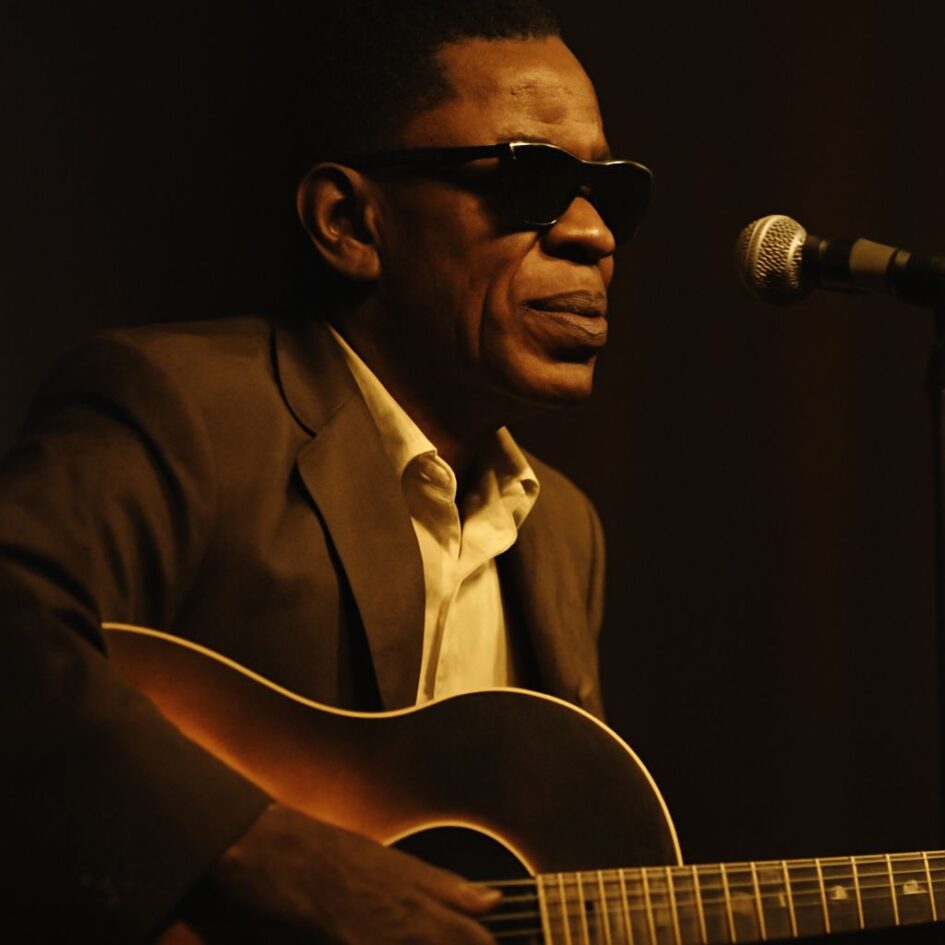
A solitary guitarist on a blues record can sound as though he worked outside any musical community. The career of Sam Hopkins tells a fuller story: his performances grew from family, local audiences, other musicians, and recording sessions that carried his Texas sound far beyond home. His stage name appears in several forms, including the familiar spelling with an apostrophe, but the records point back to the same singer and guitarist.
Lightnin’ Hopkins: A name and a Texas beginning
Sam Lightnin Hopkins was born Samuel Hopkins in Centerville, Texas, in 1912. The shortened stage name is often printed as “Lightnin’,” while some releases and catalogs use “Lightning.” Smithsonian Folkways notes that Arhoolie Records founder Chris Strachwitz used the longer spelling. Comparing an artist name with a label, recording date, and track list helps distinguish editions without assuming each spelling identifies a different person.
Hopkins grew up in a family with musical connections; his brothers Joel and John Henry also played. Texas blues developed across rural communities and cities, through local gatherings, travel, commercial recordings, and exchanges among performers. Its artists did not all sound alike, and the guitarist’s style changed with the setting. He could play alone with a guitar or work with a pianist and rhythm section.
Accounts of his early life describe an encounter with Blind Lemon Jefferson and years spent learning from older players. Details of such meetings come from later recollections and should be read as memories, not as a complete day-by-day record. What the recordings establish is a musician with an unusually flexible sense of time and a gift for turning a sung line into an immediate conversation with his guitar.
From local performance to commercial records
In 1946, Hopkins traveled to Los Angeles to record for Aladdin Records with pianist Wilson “Thunder” Smith. The pairing helped produce the stage names “Thunder” and “Lightnin’.” Their recording “Katie May,” also cataloged under variant spellings, became an early regional success. Sources differ on the precise November session date, so the year and label offer a more dependable starting point for identifying the performance.
For Lightnin Hopkins, recording was one part of a working life that also depended on performances for audiences closer to home. The guitar and voice on “Katie May” are joined by Smith’s piano, making the record a useful reminder that the accompanist helped shape the sound. Listen to the way the piano answers the vocal rather than treating it as background decoration.
In the late 1940s and early 1950s, Hopkins recorded for Houston’s Gold Star label and other companies. The Gold Star Sessions collections on Smithsonian Folkways document this period and list individual tracks and credits. Songs such as “T-Model Blues” bring together a sharply articulated guitar line and a voice that can sound conversational one moment and forceful the next.
The commercial context matters. Independent labels recorded musicians for regional markets, issued songs on singles, and sometimes returned to artists for new sessions. The title on a later compilation may not be the title on the original disc, and a reissue date is not necessarily the date of the performance. Checking label notes against a discography keeps those separate pieces of information in view.
A flexible voice and guitar
Lightnin Hopkins could make the guitar carry rhythm, bass, and melodic response at once. His thumb might establish a pulse while his fingers add a figure around the vocal. He also played electric guitar with small groups, and the amplified sound could be direct and insistent. The core of the performance was not a fixed arrangement so much as the exchange between words, instrument, and listeners.
His lines could stretch or shorten a musical phrase. That flexibility gives the impression of speech, as though the next thought arrives when it is ready rather than at a prescribed point. It also asks accompanying musicians to listen closely. Comparing a solo performance with a band recording makes the adjustment audible: other players must follow the singer’s timing as well as contribute their own ideas.
Blues lyrics often travel between performers and change in the telling. A familiar phrase may appear in several songs, while a new detail gives one performance its own character. When evaluating authorship, a listener can consult the credits on a specific release and recognize that a printed credit and the history of a musical phrase answer different questions.
New recordings and wider audiences
In 1959, folklorist Samuel Charters recorded Hopkins for an album released by Folkways. The Smithsonian’s page for that release identifies the performer and provides a track list. The album introduced his playing to many listeners in the growing folk and blues market, but it did not mark the beginning of his career. By then he had already made years of commercial recordings for Black audiences.
Lightnin’ Hopkins recorded “Mojo Hand” for Bobby Robinson’s Fire label in 1960. The performance pairs a memorable vocal with a band setting, offering a contrast to the more exposed sound of the Folkways album. Concord’s artist history identifies the label and recording year; an individual release or reissue should still be checked for its own credits. A song’s original session and the date a listener first finds it on an album may be years apart.
Lightnin Hopkins continued recording for several labels during the 1960s. At a 1964 session documented by Arhoolie, he reunited musically with his brothers Joel and John Henry. The resulting The Hopkins Brothers offers a family context that a solo portrait might miss. The recording captures different players together, not a single artist acting without influences or partners.
The guitarist also reached festival and concert audiences. Smithsonian Folkways documents a 1969 Berkeley performance later reissued as Lightnin’!; the label notes that Hopkins reacquired the music and performance rights and authorized its Arhoolie release. That history makes the album useful for hearing a live set and for seeing how ownership and reissue decisions can shape what remains available.
Listening across the years
Hopkins died in Houston in 1982, leaving a large catalog with multiple labels, titles, and spellings. His work is part of a Texas blues tradition sustained by many musicians and listeners. Its range is easier to understand when individual records are tied to their dates and collaborators instead of being treated as interchangeable examples of one timeless sound.
Begin with “Katie May” and listen for Smith’s piano. Then compare a track from the 1959 Folkways album with “Mojo Hand” and a performance from the 1969 Berkeley concert. Note the change in setting, the musicians credited, and the way the singer shapes each phrase. Those details reveal both a recognizable voice and a career that kept moving.
Sources: Smithsonian Folkways: 1959 album; Smithsonian Folkways: The Hopkins Brothers; Smithsonian Folkways: Lightnin’!; Concord artist history; Texas State University: “War News Blues”.