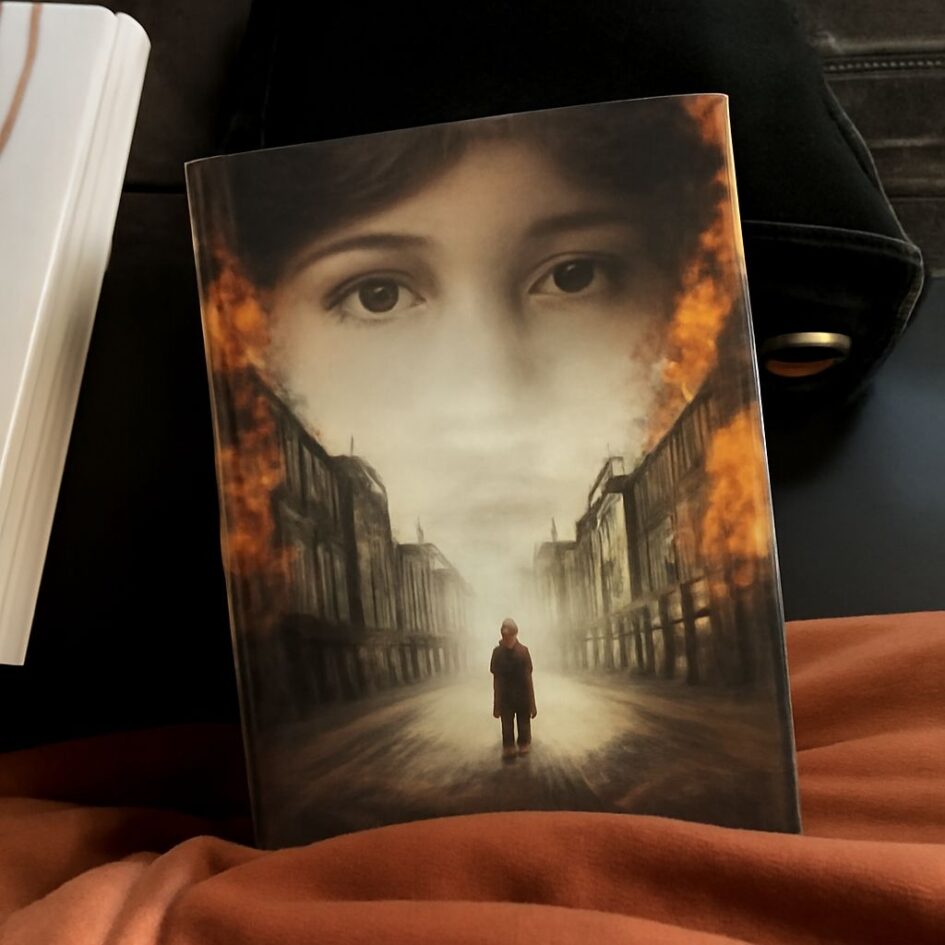
A girl retrieves a book from the ashes of a Nazi bonfire, hiding it under her coat while it is still hot. In Markus Zusak’s The Book Thief, that stolen object is both a small act of disobedience and a clue to the larger struggle over who gets to speak, read, and remember.
Readers often encounter quotations from The Book Thief before they meet its narrator. Death tells Liesel Meminger’s story from a vantage point no human witness could occupy, but his voice is also selective and personal. In The Book Thief, Death selects what to tell; his account asks readers to pay attention to the distance between an absorbing story and the historical record.
A narrator who knows the ending
In the book thief by markus zusak, Death first encounters Liesel near a railway line, after her younger brother dies. She is on her way to foster parents Hans and Rosa Hubermann in the fictional town of Molching, outside Munich. The book she takes from her brother’s graveside becomes part of her education: Hans helps her learn to read, turning a painful souvenir into a bond between them.
Death in the book thief does not keep the ending secret. He announces future losses, interrupts events, and moves between Liesel’s street and the wider war. The effect shifts attention from suspense about survival to the choices people make while they are alive. An ordinary conversation or a game with her friend Rudy acquires weight because the narrator has already shown how fragile their time is.
The narration also has limits. For Death, the book thief becomes one of the particular people who hold his attention. He reconstructs Liesel’s experience partly through the book she writes. He interprets what he sees; he is not a neutral archive. His intimacy can make suffering vivid, but no single fictional observer can represent every person persecuted under Nazism.
The book thief quotes and the stories around them
Two short quotations from Zusak’s The Book Thief, reproduced in Kirkus Reviews, reveal the narrator’s unsettled judgment: “I am haunted by humans” and “so ugly and so glorious.” The first reverses the familiar image of people haunted by Death. The second puts cruelty and generosity in uncomfortable proximity, asking how both can belong to the same species.
These quotes from the book thief gain force from their places in a story, rather than as free-standing assurances about humanity. Liesel encounters care from Hans and Rosa, but she also sees the consequences of state hatred and the danger faced by Max Vandenburg, the Jewish man hidden in their basement. The compassion of one household does not erase the system that makes hiding necessary.
Readers looking for the book thief quotes with page numbers should identify their own edition before citing a passage: pagination varies. Page references for passages in The Book Thief need to match the copy being cited. The review verifies the two short excerpts above, but does not identify their page numbers. A verified edition and pages are therefore not supplied here. For a classroom citation, use the publisher information in the copy being read and locate each passage there; a quotation collected online may come from a different printing.
A second look at quotations from The Book Thief is especially rewarding when the speaker is identified. The novel’s quoted lines carry different weight depending on who speaks them. A line voiced by Death carries his judgment, while a story written by Max has its own audience and purpose. Even a striking sentence changes meaning when it is placed beside the events that prompt it.
When words shelter and wound
In Zusak’s novel The Book Thief, Liesel’s reading lessons begin with the material at hand, including words written on a basement wall. Literacy gives her a way to make sense of a frightening world and a language for relationships she cannot otherwise explain. Later, she reads aloud to neighbors during an air raid. The reading does not stop the bombs; it gives frightened people a shared focus while they wait.
The book thief by markus zusak also shows language serving power. Nazi propaganda organizes public feeling, and the bonfire makes the destruction of unwanted books a public spectacle. The United States Holocaust Memorial Museum’s account of Nazi book burnings describes the historical campaign against works deemed contrary to Nazi ideology. Liesel’s fictional rescue of a book is more meaningful against that history, although her particular act is invented.
In The Book Thief, author Markus Zusak gives Max a different use for the printed page. He paints over pages of Hitler’s Mein Kampf to make a book for Liesel, turning a vehicle of antisemitic ideology into a surface for his own story. The gesture is intimate and resourceful, not a claim that art alone defeats the regime. Max still depends on concealment, food, and the risks taken by others.
Liesel can hurt with language too. When she lashes out at the mayor’s wife, Ilsa Hermann, the novel lets the cruelty of her words register. That scene prevents a simple division between dangerous political speech and harmless personal speech. Words acquire consequences through the people who use them and the circumstances in which they are heard.
What critics hear in Death’s voice
The book thief reviews show why the narrator divides readers. Kirkus praises the novel’s philosophical, moving writing and the way apparently separate events connect. Its response fits the book’s patient accumulation of relationships: Hans’s kindness, Rudy’s loyalty, and Max’s presence matter because the novel has spent time with them.
By contrast, Reyhan Harmanci’s San Francisco Chronicle review, excerpted by Book Marks, finds some of Death’s commentary cloying and the typographical interruptions distracting, while still praising the prose and historical framing. That reservation is persuasive when the narrator explains an emotion a scene has already made clear. His announcements can deepen a moment, but they can also crowd it.
Considered together, the reactions to Markus Zusak’s novel The Book Thief identify a real tradeoff. The unusual voice gives a familiar historical setting a distinctive shape; the same voice can call attention to itself when the characters’ actions need no further explanation. Readers’ patience with those interruptions will affect how fully the book works for them.
Fiction, testimony, and further reading
Zusak’s The Book Thief offers a constructed portrait of a German civilian family. It can prompt questions about conformity, compassion, and the circulation of ideas, but it cannot stand in for the testimony of Jewish victims and survivors. Max is a fictional character; accounts by people who experienced persecution provide evidence with their own circumstances, gaps, and distinct voices.
To read the book thief full book legally, search a public library catalog or its ebook and audiobook service by title and author. A library card may provide a loan; availability and wait times depend on the library. Print, ebook, and audio editions can also be purchased through booksellers or located through the publisher’s catalog.
After reading Zusak’s story, return to the scenes and quotations that shaped an initial response. Then explore the Holocaust Memorial Museum’s collection of survivor testimonies alongside its historical articles. Comparing a novel’s chosen perspective with individual recorded accounts gives each kind of narrative its proper weight and opens further questions about what a witness can tell us.