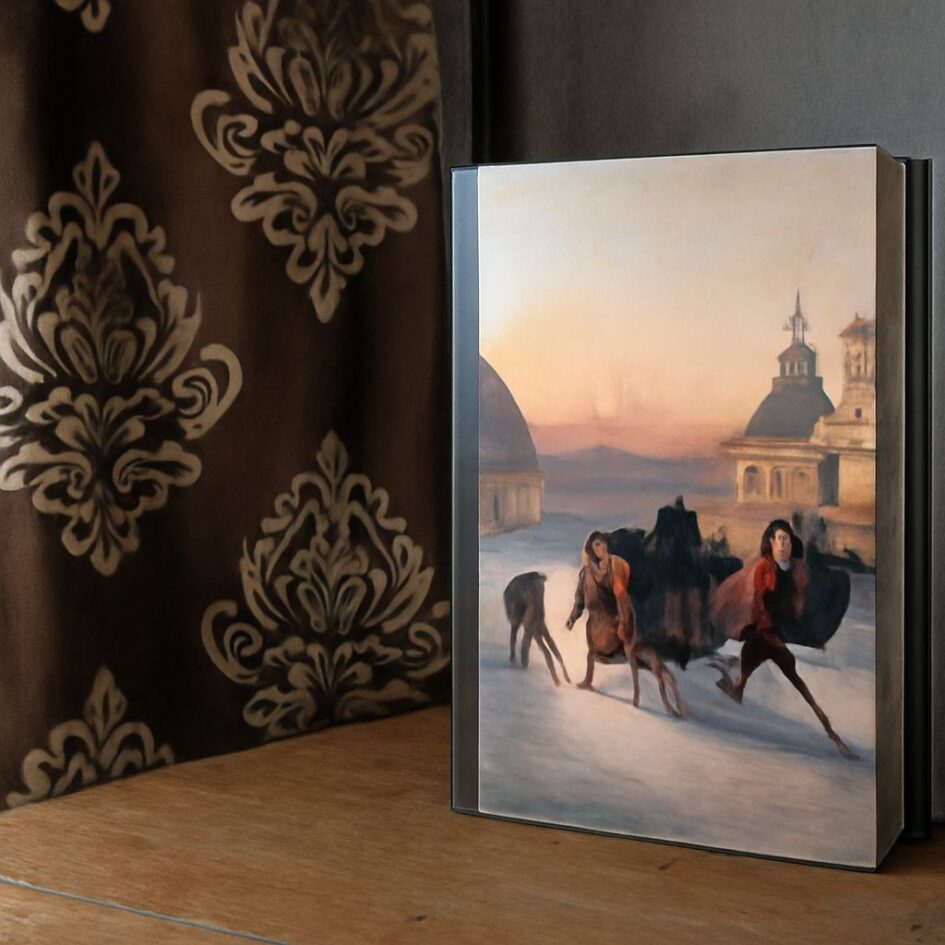
Is Tolstoy’s War and Peace worth the time it asks of a reader? For someone who enjoys intimate character stories alongside arguments about history, the answer is yes. The number of pages in War and Peace varies by edition, but its length also gives the characters room to change in ways a shorter novel might only suggest.
Is War and Peace Worth Reading for Its Characters?
The book begins in drawing rooms, among people who know how to speak and behave in company. Soon those rooms open onto family estates, military camps, and battlefields. Tolstoy follows several families during the Napoleonic era, showing how public events enter private lives: an inheritance alters a young man’s place in society, a journey to war changes a soldier’s ambitions, and a family makes decisions under the pressure of an approaching army.
Pierre Bezukhov, Prince Andrei Bolkonsky, and Natasha Rostov offer different ways into that world. Pierre searches for a life that means more than the position he has inherited. Andrei looks for purpose and distinction. Natasha begins with a lively confidence that the passing years complicate. The pleasure lies partly in watching them act, misunderstand themselves, and respond to the consequences.
The novel does not keep its attention on one hero. A chapter can move from a crowded party to a character’s private thoughts, then leave that person for a very different setting. The shifts give the reader a wide view, but they ask for patience. Someone seeking a single plot that advances without interruption may find the movement frustrating.
A War and Peace book review should also account for the social world around the central figures. Relatives, officers, servants, and acquaintances shape what the main characters can do. Tolstoy often reveals a relationship through a small gesture or an awkward conversation rather than an announcement of what a character feels. Those details reward attention, even when the next major event is still some pages away.
War, Power, and the Limits of a Great Leader
The battle scenes are not simply a record of generals giving orders. Tolstoy places people amid confusion, distance, smoke, and incomplete information. A command conceived at headquarters must pass through many hands and meet circumstances no one fully controls. The result can differ sharply from the plan.
That experience connects to the book’s arguments about history. Tolstoy questions explanations that assign a vast event to the will of one famous leader. Napoleon appears within a much larger movement of armies, political choices, chance, and ordinary people. The novel asks what power looks like when no individual can see or direct everything that happens.
For readers who like fiction to stay inside scenes and dialogue, the author’s direct historical reflections may feel like a detour. They slow the story and sometimes repeat an argument from another angle. For others, they are part of the point: the same book that lets a reader feel a character’s uncertainty also challenges neat accounts of why history happened.
This War and Peace review favors the combination, though it is an uneven one. The close attention to people makes the larger argument more than a lecture; the argument, in turn, gives the domestic scenes a wider setting. Whether reading War and Peace is worthwhile depends partly on a reader’s tolerance for those changes of pace.
How Many Pages Does an Edition Have?
How many pages is War and Peace? There is no single count for every English edition. Translation, type size, page dimensions, notes, introductions, and the number of physical volumes all affect the printed total. A larger page count can reflect more supplementary material or a different layout, not necessarily a longer story.
For a concrete comparison, Penguin Random House lists an Anthony Briggs translation at 1,440 pages. The publisher lists an Everyman’s Library three-volume set using the Louise and Aylmer Maude translation at 1,736 pages. These are publisher counts for particular editions, not interchangeable estimates for every copy.
The War and Peace pages in one printing can hold more words than pages in another. An e-book adds another variable: changing the font or screen size changes how much text appears at once. Readers comparing the page length of War and Peace should therefore compare the editions they can actually borrow or buy.
For War and Peace how many pages appear in the book depends on the edition. Short chapters provide natural places to stop, though some scenes and arguments invite a slower reading. A few chapters at a time can make the length manageable without turning the book into a race.
Translation, Names, and a Low-Cost Trial
English readers have a choice of translations, and the difference is more than the number of pages in War and Peace. Rhythm, word choice, notes, and the treatment of French dialogue can affect the experience. An edition with a character list or historical notes may be helpful when names and titles begin to accumulate. The same person can appear under a formal name, a shortened name, or a family name.
The most useful comparison is a few pages of the same scene in two translations. One may sound more natural to a particular reader even when both convey the action clearly. A public library can offer print or digital editions, subject to its collection and lending rules.
For a free starting point, Project Gutenberg offers the Maude translation of War and Peace online in the United States, including browser-readable and downloadable formats. Its listing identifies the text as public domain in the United States. Reading the opening chapters is a practical test of the prose and the social setting before choosing a longer commitment.
The page total for War and Peace is useful for planning, but the better question is whether its scenes make the reader curious about the people in them. A reader drawn to Pierre’s uncertainty or the tensions of a family gathering has a reason to continue. The novel rewards a sustained reading when those private moments matter as much as the historical sweep.
The BBC Adaptation Is a Different Work
The BBC’s 2016 adaptation, written by Andrew Davies, condenses the story into six episodes. In the BBC’s production materials, Davies describes arranging the adaptation around the families and compressing a large story for television. A War and Peace 2016 review can assess performances, pacing, and visual storytelling; it cannot stand in for an assessment of Tolstoy’s prose or his extended arguments about history.
The series may be a useful way to see the principal relationships and settings. It also makes choices about what to show and what to leave out. A viewer who enjoys the adaptation may still find the novel slower and more reflective. A viewer who finds the series rushed may discover that the book allows a scene or a thought much more space. An evaluation of Tolstoy’s novel is stronger when it considers those qualities on the page. For readers drawn to character-driven fiction, the novel earns the time spent with it.
Is War and Peace worth reading? Choose the book if the prospect of living with its people and ideas appeals more than reaching the end quickly.