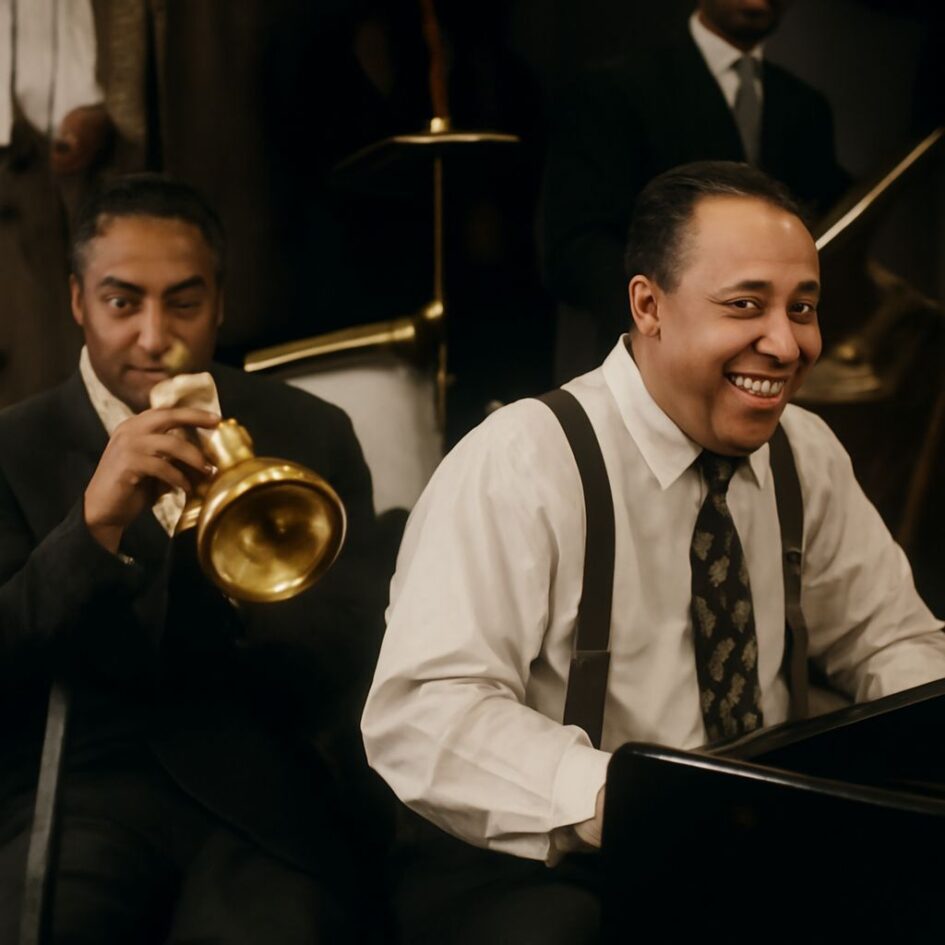
What made a trumpet and an alto saxophone sound like a new direction in jazz? The partnership of trumpeter Gillespie with saxophonist Charlie Parker brought intricate melodies, quick turns, and improvisation into close conversation. Their recordings offer a way to hear bebop taking shape through the work of two players and the musicians around them.
Gillespie’s career reached beyond that partnership. He was a composer, bandleader, and an important figure in Afro-Cuban jazz as well as a virtuoso instrumentalist. To understand his work, it helps to listen to a particular performance, then check who else was in the room and which release carries it.
Dizzy Gillespie and Charlie Parker: a musical conversation
John Birks Gillespie was born in Cheraw, South Carolina, in 1917 and died in 1993. The National Endowment for the Arts describes his early training, his work in major bands, and his role alongside Parker in bebop. He learned trumpet as a teenager and worked with groups including Earl Hines’s orchestra before leading his own ensembles.
A Dizzy Gillespie biography can list the bands and dates, but the records show what those facts sounded like. Bebop placed demanding melodic lines and harmonies in the hands of improvisers who could move rapidly through them. Gillespie’s trumpet could dart across the beat while Parker’s alto saxophone answered with its own fluent lines. A shared theme gave them a place to begin; their solos opened different paths through the same structure.
Dizzy Gillespie and Charlie Parker were central figures in a wider community, not a self-contained movement. Pianists, bassists, drummers, arrangers, and other horn players helped give the music its shape. Listening to the rhythm section is one way to hear the collaboration: piano chords and drum accents shift underneath the horns, while the bass provides a moving foundation.
The story of the two musicians also extends into a broader Black musical history. Bebop grew through musicians’ exchanges in clubs, bands, and recording studios. Its demanding sound was made by working artists developing ideas together, and the records preserve particular moments in that ongoing exchange rather than a single origin point.
What Bird and Diz contains
The album title joins Parker’s nickname, Bird, to Gillespie’s. Their June 6, 1950, New York session brought the trumpeter and saxophonist together with Thelonious Monk on piano, Curley Russell on bass, and Buddy Rich on drums. Try “Bloomdido” for the exchange between the horns and the contrast supplied by Monk’s piano. The session and release history gives the personnel and helps separate this date from other sessions on the album.
The original 1952 Clef ten-inch album included “Passport” and “Visa,” recordings made in 1949 with Parker and different musicians, without Gillespie. Later editions changed the selection and added alternate takes. Consequently, an album page’s combined personnel list is not proof that every named player appears on every track. Check the individual track’s session date and credits when the distinction matters.
An edition may also arrange the same tune beside several takes. Those are separate performances from a session, not necessarily different compositions. Comparing them can reveal how improvisation changes while a melody remains recognizable. A reissue’s release year tells when that edition appeared; the recording date tells when the musicians played.
Two performances of “Salt Peanuts”
The tune is credited to Gillespie and drummer Kenny Clarke in the Massey Hall release notes. A composer credit describes the writing of a piece; it does not mean Clarke plays drums on every recording of it. That distinction is especially helpful when comparing two versions with different rhythm sections.
On May 11, 1945, the trumpeter recorded “Salt Peanuts” in New York with Parker on alto saxophone, Al Haig on piano, Curley Russell on bass, and Sid Catlett on drums. The session discography identifies the recording and its original issue on Guild 1003. This compact studio performance gives the listener a tightly framed statement of the tune and a chance to follow the horns against Catlett’s drive.
On May 15, 1953, Charlie Parker and Dizzy Gillespie played the piece at Massey Hall in Toronto with Bud Powell on piano, Charles Mingus on bass, and Max Roach on drums. Parker appeared as Charlie Chan in some credits. The live setting leaves more room for the music to stretch, and the change from Haig, Russell, and Catlett to Powell, Mingus, and Roach changes the support beneath the two horns.
For Dizzy Gillespie, “Salt Peanuts” could travel from a concise studio side to an extended concert performance. Listen for how the familiar theme returns after improvisation and how the drummers shape the energy differently. The 1953 recording also exists in versions with and without a later bass overdub, so a comparison should identify the specific edition rather than assume every digital copy presents the same mix.
In “Salt Peanuts,” Dizzy Gillespie used a recurring theme that listeners can follow across both dates and many others. Compare the venue, year, and accompanying players before drawing conclusions about the performance. The original Bird and Diz album and these two “Salt Peanuts” recordings are distinct listening stops; the tune is not on that original album.
A wider career and a listening route
Gillespie’s work with Cuban percussionist Chano Pozo expanded the sound of his orchestra. The Smithsonian’s collection guide identifies him as a principal developer of Afro-Cuban jazz as well as bebop. A recording such as “Manteca” offers a different entry into his career: listen to the relationship between the percussion, the brass section, and the soloist, then look up the arrangement and the musicians who made it.
The relationship between Parker and the trumpeter remains a useful thread through these records, but it need not be the only one. Following a pianist or drummer from session to session reveals other networks and choices. The 1950 studio session, the 1945 Guild side, and the 1953 concert each put familiar names in a different setting.
For the next listen, choose the shorter 1945 studio performance for its compact ensemble statement or the 1953 concert for its extended live playing. Search the title and date in the linked discography or release notes, then compare the track-level personnel and edition details with the copy available through a library, retailer, or listening service.