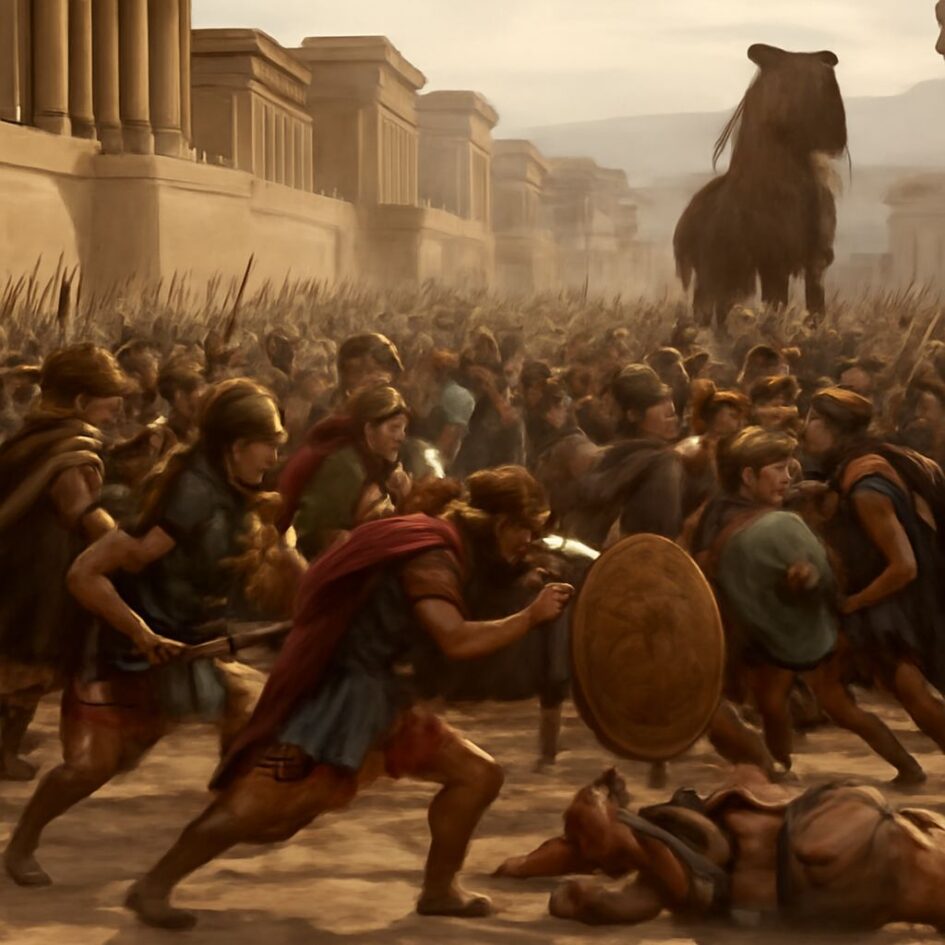
The Trojan War, a legendary conflict between the Greeks and the city of Troy, holds a significant place in Greek mythology and ancient literature. While the exact dates of the war remain a subject of debate, it is generally believed to have occurred in the late Bronze Age. Traditionally, historians and scholars often cite the period around the 12th or 13th century BCE, with many placing the events around 1184 BCE. This timeline aligns with the archaeological evidence and the mythological tales that have been passed down through generations.
Timeline of the Trojan War
The timeline of the Trojan War is primarily derived from mythological sources, as direct historical evidence is scarce. According to tradition, the war lasted ten years, culminating in the fall of Troy. The conflict began after Paris of Troy abducted Helen, the wife of Menelaus, king of Sparta. This event sparked a coalition of Greek forces led by Agamemnon, Menelaus’s brother, to wage a prolonged siege against Troy.
Throughout these ten years, numerous battles and significant events took place, including the famous duel between Paris and Menelaus, the exploits of Achilles, and the cunning strategy of the Trojan Horse, which ultimately led to the Greek victory and the sacking of Troy.
What is the Trojan War?
The Trojan War is a central event in Greek mythology, representing a battle between the Greeks (Achaeans) and the inhabitants of Troy. This war was not merely a historical conflict but a rich tapestry of myth, involving gods and heroes whose actions were chronicled in epic poems such as Homer’s “Iliad” and “Odyssey.” These stories detail the heroic deeds and tragic fates of figures like Achilles, Hector, and Odysseus, and the divine interventions that influenced the course of the war.
Fascinating facts about the Trojan War
- The war was said to be fought over Helen, who was described as the most beautiful woman in the world.
- The Trojan Horse, a deceptive wooden structure used by the Greeks to infiltrate Troy, has become synonymous with cunning strategy.
- Despite its mythological narrative, the location of Troy is believed to be in present-day Turkey, near the Dardanelles.
- The war’s narrative includes divine interventions from gods such as Athena, Apollo, and Zeus, who took sides and influenced outcomes.
- The “Iliad” only covers a few weeks of the final year of the war, while the “Odyssey” details the journey of Odysseus post-war.
Troy in Greek mythology
Troy, known as Ilium in ancient texts, served as the setting for one of the most enduring stories in Greek mythology. Its strategic location made it a wealthy and powerful city. The mythological accounts portray Troy as a city deeply intertwined with the gods, where divine and mortal actions intertwined to weave a complex narrative of heroism, betrayal, and destiny. The ruins of what is believed to be ancient Troy were uncovered in the 19th century by Heinrich Schliemann, providing tangible links to the legendary tales.
These mythological narratives and archaeological findings continue to captivate historians, archaeologists, and enthusiasts, keeping the story of the Trojan War alive in popular culture and academic discourse.