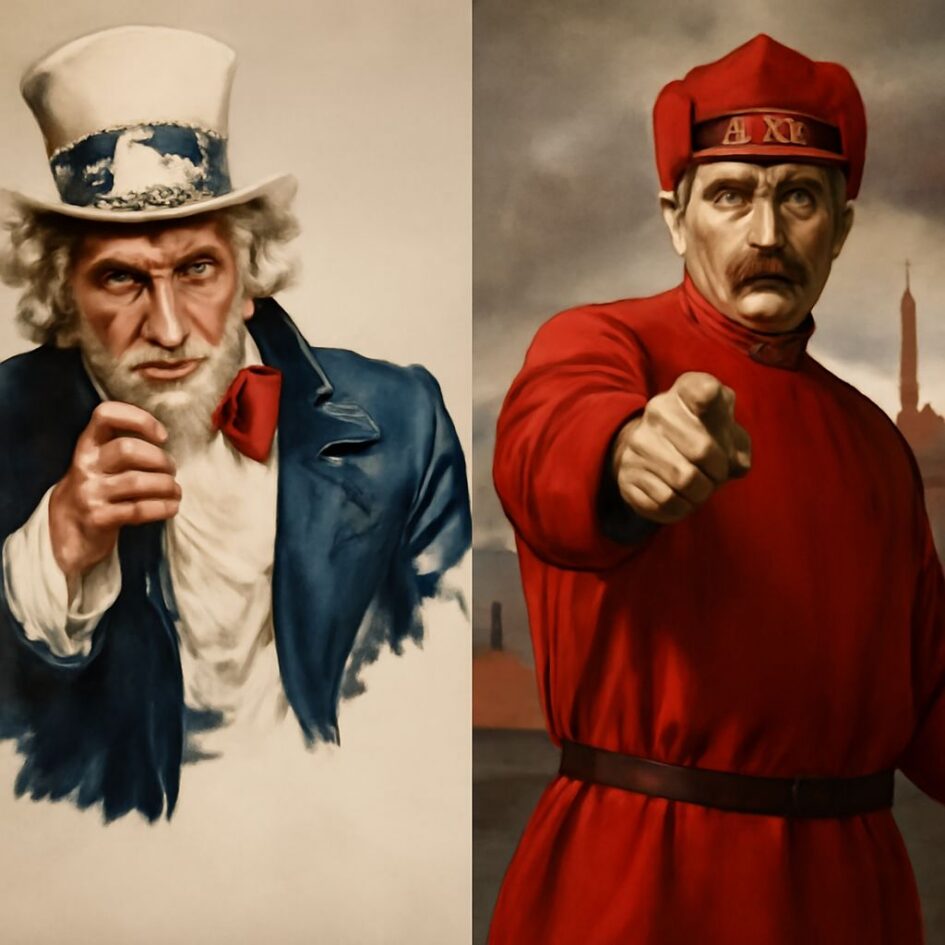
The purpose of propaganda in Russian revolutionary and Civil War posters was practical: to turn political claims into public action. Posters urged people to enlist, increase production, support the new government, accept sacrifice, and oppose its enemies. Their bold colors, short slogans, and simplified figures made complex events understandable to audiences with different levels of literacy.
These images were not neutral records of events. They presented a chosen political interpretation and attached a desired response to it. A heroic worker was meant to inspire labor, a determined soldier to encourage enlistment, and a grotesque enemy to produce fear, anger, or vigilance.
Purpose of propaganda: the actions posters demanded
Posters functioned as public instructions during the upheavals of 1917 and the Civil War that followed from 1918 to 1921. They competed with newspapers, speeches, religious messages, and rumors, but had one advantage: a poster could communicate quickly in a railway station, factory, village, or military camp.
The main demands were connected:
- Enlistment: Men were encouraged to join the Red Army and defend the revolution.
- Production: Workers were told that coal, grain, weapons, transport, and repaired machinery were essential to victory.
- Loyalty: Citizens were asked to support Soviet power rather than the old monarchy, rival parties, or White armies.
- Sacrifice: Hunger, labor, requisitioning, and military service were framed as necessary contributions.
- Hostility: Political opponents were represented as threats responsible for war, exploitation, or national betrayal.
Russian revolution propaganda posters: enlistment and production
Russian revolution propaganda posters often addressed workers and soldiers as the leading forces of historical change. A worker might appear muscular, upright, and larger than surrounding figures, while a soldier carried a rifle or red banner. These visual choices linked physical strength with political legitimacy and suggested that ordinary people could build a new society.
Enlistment posters used direct commands, pointing figures, and forward movement. Dmitry Moor’s famous 1920 Red Army recruitment image, commonly translated as Have You Enlisted as a Volunteer?, shows a soldier pointing toward the viewer. The direct gaze turns a general political appeal into a personal obligation.
Production posters treated factories, railways, and fields as battlefronts. Machinery, smokestacks, tools, and organized groups of workers conveyed urgency and collective discipline. The intended response was not admiration alone; it was longer hours, repaired equipment, increased output, and acceptance of labor as military service.
Russian Civil War propaganda: loyalty and sacrifice
Russian Civil War propaganda presented loyalty to the Bolshevik government and Red Army as protection against the return of landlords, capitalists, monarchy, or foreign intervention. Red stars, banners, rifles, and revolutionary crowds signaled unity and organized power. Posters often used diagonal lines and strong contrasts to make the revolution appear energetic and unstoppable.
Sacrifice was made meaningful through comparison. A poster could contrast a disciplined Red fighter or worker with starving families, destruction, or an enemy depicted as greedy and destructive. This framing asked viewers to endure shortages and personal loss because the alternative appeared worse. Peasants were urged to provide grain, while urban workers were urged to maintain factories and transport.
Hostility toward enemies: symbols, audiences, and public anger
Enemy imagery simplified a fragmented conflict into recognizable types. White officers, wealthy landlords, foreign soldiers, priests, and capitalists could be shown with exaggerated clothing, large bodies, hooked noses, weapons, or animal-like features. Such caricatures did not describe every opponent accurately; they made political categories emotionally immediate.
The intended audience shaped the message. Soldiers received appeals to courage and comradeship. Workers saw tools, factories, and collective strength. Peasants were addressed through grain, land, and family security. Urban readers encountered dramatic scenes that connected military victory with food and public order.
El Lissitzky’s Beat the Whites with the Red Wedge demonstrates this visual logic especially clearly: a red wedge penetrates a white circle, turning political conflict into a simple image of force breaking resistance. The design required little text and directed anger toward a defined enemy, making propaganda effective even when viewers had only seconds to interpret it.