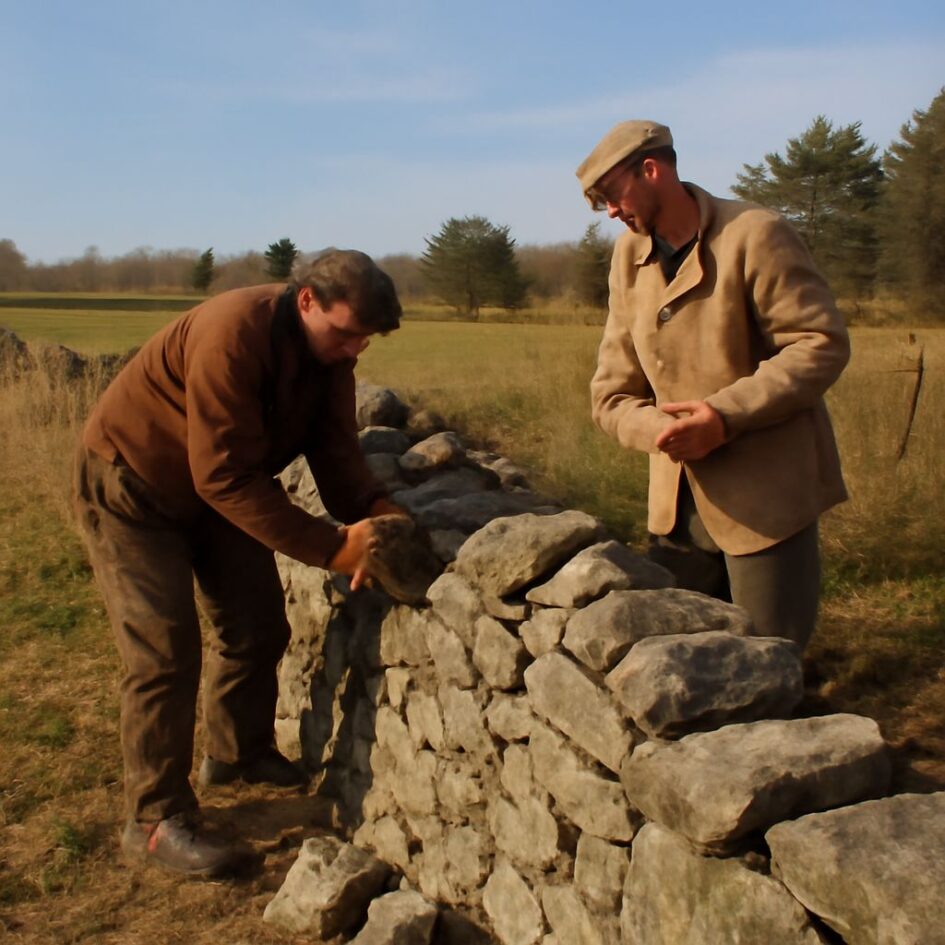
Mending Wall by Robert Frost stands as one of the most recognized and studied poems in American literature. First published in 1914 as part of Frost’s second collection, “North of Boston,” the poem explores the annual ritual of repairing a stone wall between two neighbors. Through its conversational tone and rural setting, Mending Wall raises fundamental questions about boundaries, tradition, and human connection.
Overview of Mending Wall by Robert Frost
Mending Wall by Robert Frost is a narrative poem set in the rural landscape of New England. The poem’s speaker recounts an early spring ritual in which he and his neighbor meet to repair the stone wall that separates their properties. Over the course of forty-five lines, Frost creates a dialogue between two different worldviews: one that questions the necessity of boundaries and another that steadfastly upholds them.
The poem opens with the memorable line, “Something there is that doesn’t love a wall,” immediately setting up a tension between natural forces and human constructs. The speaker observes that frost heaves, hunters, and animals all contribute to the wall’s deterioration, and yet, each year, he and his neighbor carefully restore it. The neighbor’s refrain, “Good fences make good neighbors,” encapsulates his practical and traditional outlook.
While the poem unfolds as a seemingly simple account of rural labor, Frost uses this encounter to probe larger social and philosophical issues. The speaker questions whether the wall is needed at all, since there are no livestock to contain—just apple trees on one side and pine trees on the other. This distinction opens the poem to broader interpretations about the purpose and consequence of barriers, both physical and metaphorical.
Summary of the Mending Wall poem
The Mending Wall poem begins with the speaker reflecting on how nature seems to work against the wall. Stones fall, gaps appear, and mysterious forces undo the work of the previous year. Despite these natural disruptions, the speaker initiates the annual mending with his neighbor, gathering stones and resetting them as they walk along each side of the wall.
As they work, the speaker tries to engage his neighbor in a friendly debate about the necessity of the wall. He points out that neither man has anything that might “offend” the other or require a barrier. The neighbor, however, is unmoved and repeats his father’s saying: “Good fences make good neighbors.” The speaker playfully imagines his neighbor as an “old-stone savage,” moving in darkness and guided by tradition rather than reason.
The poem closes without resolution. The wall is rebuilt, but the speaker’s skepticism remains, as does the neighbor’s adherence to inherited wisdom. Frost leaves the reader with the image of two men, side by side, divided yet connected by the wall and the act of mending it.
Themes and interpretation
At its core, Mending Wall by Robert Frost is a meditation on boundaries—literal and figurative. The most prominent theme is the tension between tradition and change. The neighbor represents the unquestioning acceptance of inherited customs, while the speaker embodies curiosity and skepticism about their necessity. The repeated phrase, “Good fences make good neighbors,” encapsulates the persistence of tradition, even when it may no longer serve a practical purpose.
The poem also addresses the relationship between humans and the natural world. Nature repeatedly breaches the wall, suggesting that boundaries are artificial constructs that nature itself resists. This dynamic raises questions about the extent to which humans should impose order on the environment, and whether such efforts ultimately foster or hinder genuine connection.
Another key theme is the complexity of neighborly relationships. The wall both separates and brings the men together, making the act of mending a paradoxical ritual that maintains distance even as it requires cooperation. This ambiguity underscores the poem’s enduring relevance to questions of community, individuality, and the role of tradition in shaping human interaction.
Poetic techniques and style
Frost’s style in Mending Wall poem is marked by conversational language, blank verse, and vivid imagery. The poem is written in unrhymed iambic pentameter, which gives it a natural, flowing rhythm that echoes the spoken word. Frost’s use of everyday speech creates intimacy and accessibility, drawing readers into the rural setting and the speaker’s reflective mood.
Imagery plays a crucial role, particularly in describing the wall and the landscape. Frost crafts tactile images of the stones, the gaps, and the physical labor of mending. The wall itself functions as a powerful symbol, representing boundaries of all kinds—personal, social, and psychological.
Frost also employs irony and subtle humor, especially in the speaker’s musings about elves and the neighbor’s stubbornness. The poem’s structure—its cyclical pattern of destruction and repair—mirrors the repetitive nature of tradition. Through these techniques, Frost encourages readers to question the value of boundaries and consider the forces, both natural and human, that shape them.