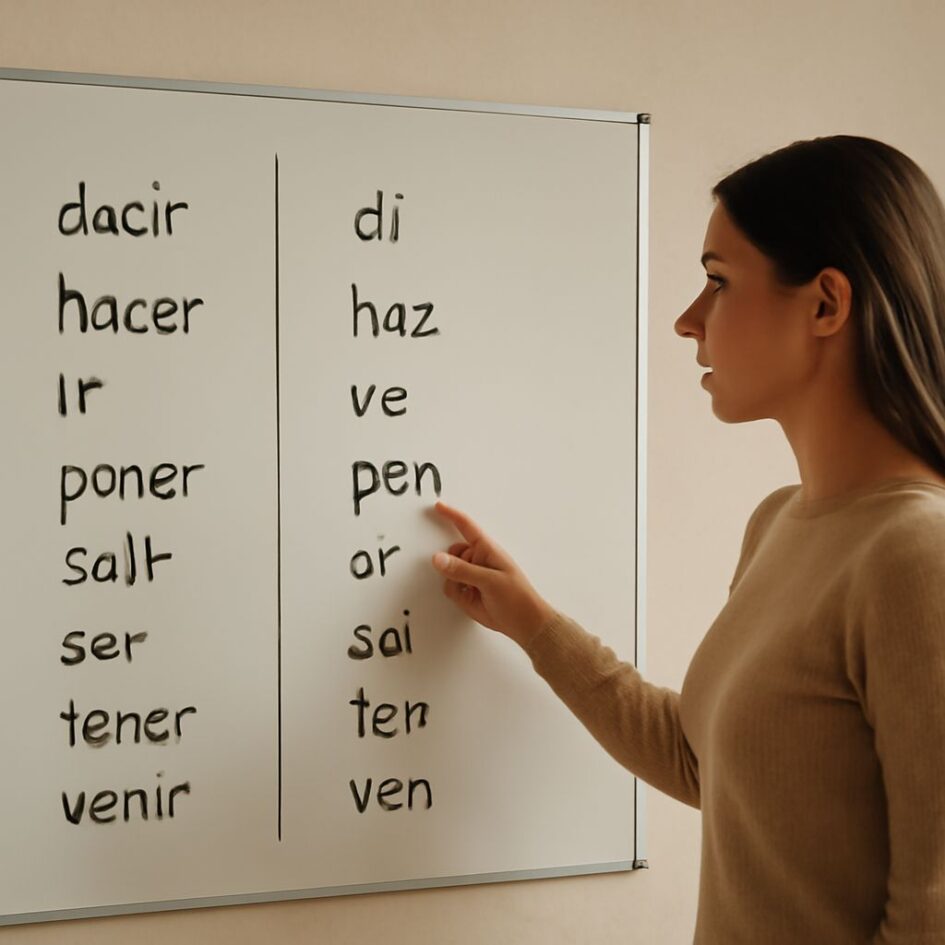
Mastering the use of “tu” in Spanish is essential for effective communication in informal settings. This involves understanding “tu” conjugation, forming “tu” commands, and grasping the nuances of the “ser tu command.” In this guide, we will break down these elements with practical examples to enhance your fluency and confidence in conversational Spanish.
Understanding ‘tu’ conjugation
The “tu” conjugation is specific to the second person singular, informal form in Spanish. It is used when addressing friends, family members, or others with whom you have a close relationship. Unlike the formal “usted” form, “tu” is more relaxed and is commonly used in everyday conversation.
For regular verbs, “tu” conjugation follows a predictable pattern. For -ar verbs, the ending changes to -as. For example, “hablar” (to speak) becomes “hablas” when conjugated with “tu.” Similarly, for -er and -ir verbs, the ending changes to -es. For example, “comer” (to eat) becomes “comes” and “vivir” (to live) becomes “vives.”
Forming informal ‘tu’ commands
Informal “tu” commands are used to give direct instructions, requests, or suggestions to someone you address as “tu.” The formation of these commands is straightforward for positive commands but slightly different for negative ones.
For affirmative informal commands, the verb is usually in its third person singular form. For instance, “hablar” becomes “habla,” “comer” becomes “come,” and “vivir” becomes “vive.” Some irregular verbs have unique command forms, such as “decir” transforming into “di” and “hacer” into “haz.”
Negative informal commands, on the other hand, are formed using the “tu” form of the present subjunctive. For example, “no hables,” “no comas,” and “no vivas” for “do not speak,” “do not eat,” and “do not live,” respectively.
Exploring the ‘ser tu command’
The “ser tu command” is an example of an irregular verb command that might seem tricky at first. In its affirmative form, “ser” becomes “sé,” as in “sé paciente” (be patient). This command is short and often used. For its negative form, “ser” becomes “no seas,” as in “no seas impaciente” (do not be impatient).
Understanding these distinctions in “ser tu command” is crucial to mastering informal commands, as it helps convey specific instructions with clarity and precision in interpersonal communication.
By comprehending these aspects of the “tu” conjugation and command forms, learners can effectively engage in informal dialogues, establish rapport, and navigate diverse conversational scenarios in Spanish.