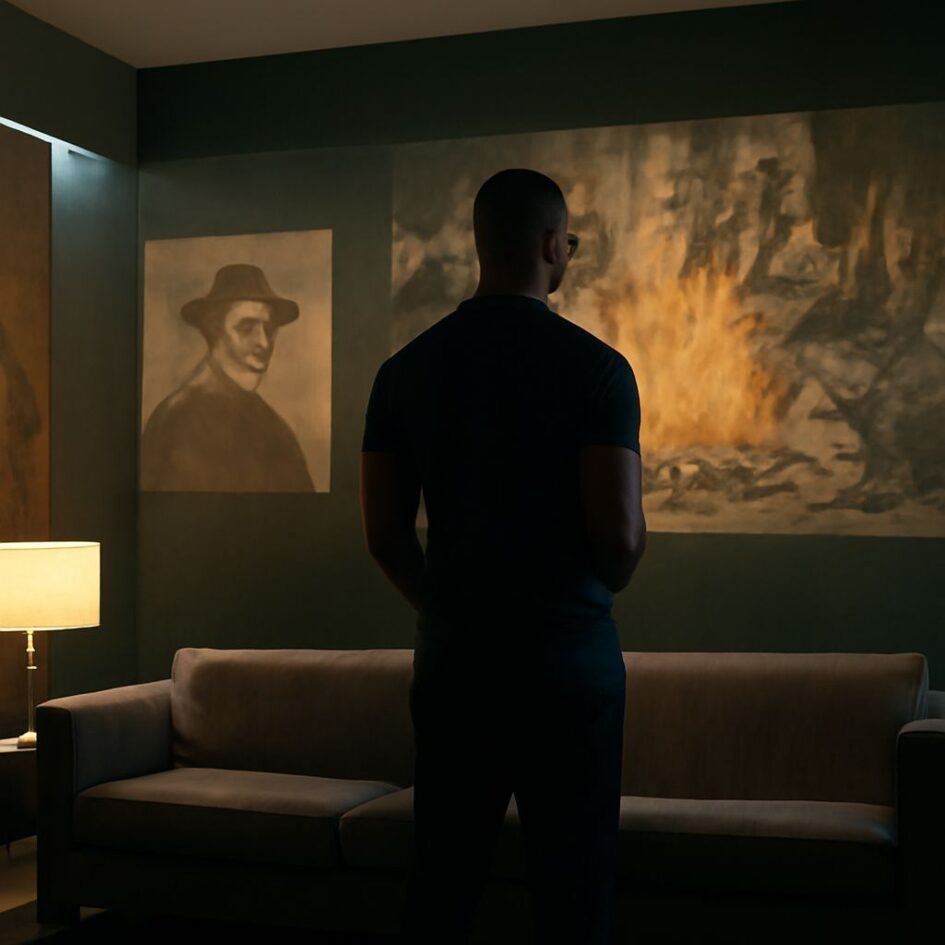
In Ray Bradbury’s Fahrenheit 451, the Fahrenheit 451 parlor walls are immersive television screens that fill much of a room and imitate a social world. They do more than entertain: they organize attention, replace conversation, and make passive consumption feel like family life.
Across the first two parts, the walls move from a background feature of Mildred’s home to an obstacle to Montag’s reading. They keep residents busy, emotionally insulated, and less willing to examine war, censorship, or their choices.
What the Fahrenheit 451 parlor walls are
Bradbury describes a parlor as a room lined with large screens, normally three walls of televised action. Programs address viewers as participants through familiar characters and rapid dialogue. Mildred calls recurring performers her “family,” although the relationship is scripted and commercial. Seashell earbuds intensify the sound; they are separate from the walls but part of the same media environment.
A fourth wall is possible but expensive, and Mildred wants one installed. The detail shows a system designed to fill domestic space. The parlor is not an occasional screen. It is the home’s main social setting, with attention and emotional energy arranged around it.
Fahrenheit 451 Part 1: Mildred and the parlor family
In Fahrenheit 451 Part 1, Mildred’s attachment to the walls establishes their effect on family life. She spends much of her day with the “family,” treats its scripted exchanges as meaningful contact, and remains distant from Montag. She cannot remember where they met and responds to serious conversation with discomfort or a return to programs.
Montag recognizes the walls’ danger through this contrast. Mildred’s overdose is handled as a routine mechanical problem, while the parlor quickly resumes its place. When Montag brings books home, the screens represent the routine he is beginning to reject. Mildred fears the books partly because they interrupt the safe entertainment supporting her identity. The walls help censorship work at household level: distraction becomes self-enforcing.
Fahrenheit 451 Part 2: When the walls confront Montag’s reading
In Fahrenheit 451 Part 2, the conflict becomes public and ideological. Montag shuts off the parlor walls while speaking with Mildred and her friends, Mrs. Phelps and Mrs. Bowles. They want the “family” restored because silence makes their loneliness visible. Their talk about politics, marriage, and war shows how televised reassurance has replaced reflection: they repeat official confidence while showing little concern for war’s consequences.
Montag’s reading of poetry breaks this pattern. The women react with distress, and Mildred tries to restore familiar media. The walls control without issuing explicit commands. They keep attention moving, discourage sustained thought, and make difficult knowledge seem abnormal. After Mildred reports Montag, Beatty orders him to burn his house and its parlor walls. Their destruction turns his private rejection of the system into open conflict.
What the walls symbolize: entertainment as social control
The parlor walls symbolize a society that has confused constant stimulation with connection. They entertain by offering speed, intimacy, and the illusion of participation, but they also narrow the range of acceptable feeling. Viewers can react to a program, yet they have little space to remember, reason, or disagree.
Their political power comes from this management of attention. A citizen absorbed in a fabricated family is less likely to notice the emptiness of real relationships or question official narratives. Bradbury does not present the walls as dangerous only because they display false stories. Their deeper danger is that they make passivity comfortable. Montag’s growing resistance begins when he turns away from the screens long enough to read, listen, and face other people without a script.