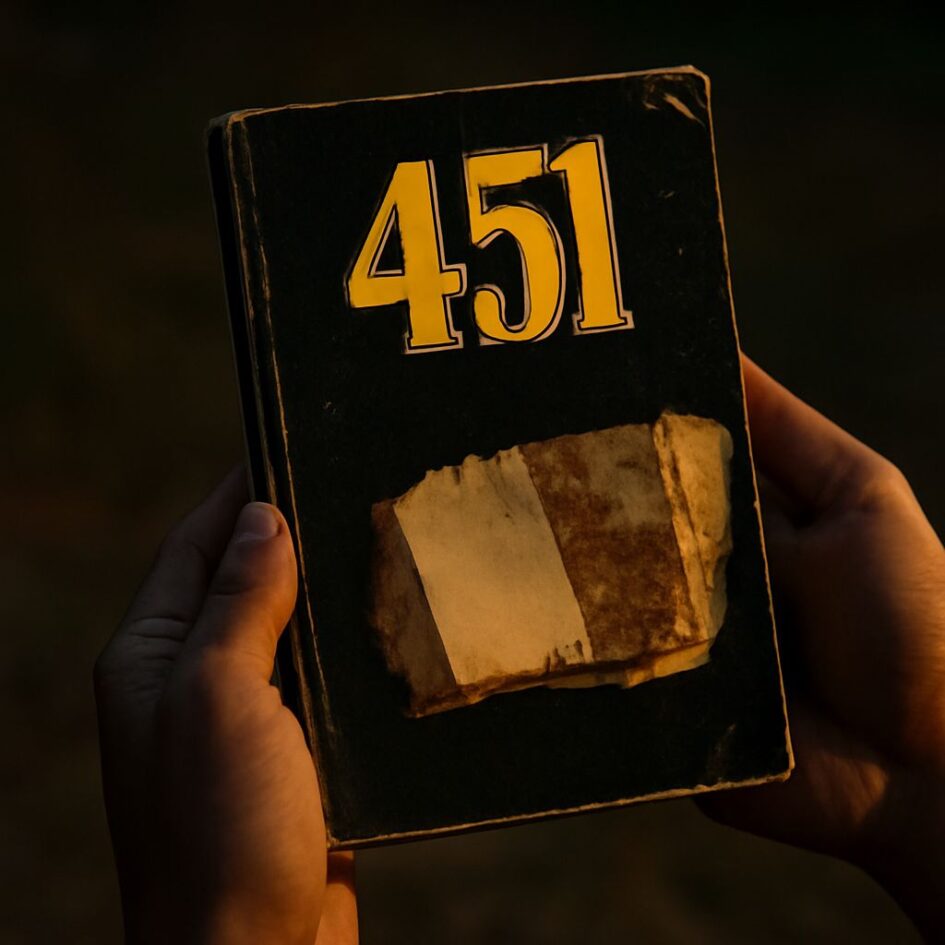
A Fahrenheit 451 book cover often makes the novel’s conflict visible immediately: fire consumes pages while the book remains something worth saving. Flames, ash, matches, and phoenix imagery recur because Ray Bradbury’s story connects destruction with memory, renewal, and resistance to conformity.
The imagery belongs to the novel’s fictional world; the real restrictions are different. Fahrenheit 451 has been challenged in schools and libraries mainly over language, sexual references, violence, and suitability for younger readers.
Fahrenheit 451 book cover motifs: fire, pages, and the phoenix
Fire dominates most editions. Many show an open book surrounded by flames or pages curling into ash. Others reduce the design to a match, burning page, or the numerals 451 in red or orange type. The number identifies the title while the flames invoke its premise: a society employs firemen to destroy books.
Some covers add a fireman’s helmet, mechanical hound, or city lit by fire. The helmet suggests state authority; the hound suggests surveillance and pursuit. A phoenix rising from flames represents destruction followed by renewal, and warns that societies can repeat their mistakes.
How fire-and-book imagery expresses the novel’s themes
Cover fire-and-book imagery expresses more than a literal plot device. A burning page can represent the loss of individual thought, historical memory, and language. When books disappear, citizens lose access to competing accounts and difficult ideas. A blank or half-burned page suggests incomplete public memory.
Fire also has an ambivalent meaning. It destroys, but it provides light and warmth; that tension mirrors Montag’s movement from obedient fireman to curious reader. The phoenix adds the possibility of recovery: knowledge may be suppressed, yet survive in people who remember, teach, and rebuild.
How restrictions on Fahrenheit 451 differ from the novel’s book burning
The novel’s fictional book burning and real-world restrictions are separate. In Bradbury’s story, firemen systematically burn books, while censorship, mass entertainment, and social pressure discourage sustained thought. Book destruction is a tool of authoritarian control.
In real life, a challenge usually starts with a parent, educator, administrator, or community group objecting to a book’s use or availability. A school may remove it from required reading, limit it to older students, require permission, or use an edited edition. A library challenge may seek relocation or removal rather than destruction. A search for Fahrenheit 451 banned can combine these actions, even though they do not create the novel’s nationwide fictional system.
Why was Fahrenheit 451 banned or challenged? Objections over profanity, sex, and violence
Most documented challenges focus on content considered unsuitable for younger readers. Objections commonly cite:
- Profanity: frequent mild or strong language, including words removed from some classroom editions.
- Sexual content: references to sex, abortion, and relationships presented without the protective framing some adults expected for school reading.
- Violence and distress: suicide attempts, war, murder, state violence, and the burning of people and homes.
Some challengers also object to anti-authoritarian implications, bleak mass-media themes, or treatment of religion. In the late 1960s, a school edition altered words and passages; later editions restored the complete text. “Banned” may therefore mean local removal, restriction, or challenge rather than nationwide prohibition.