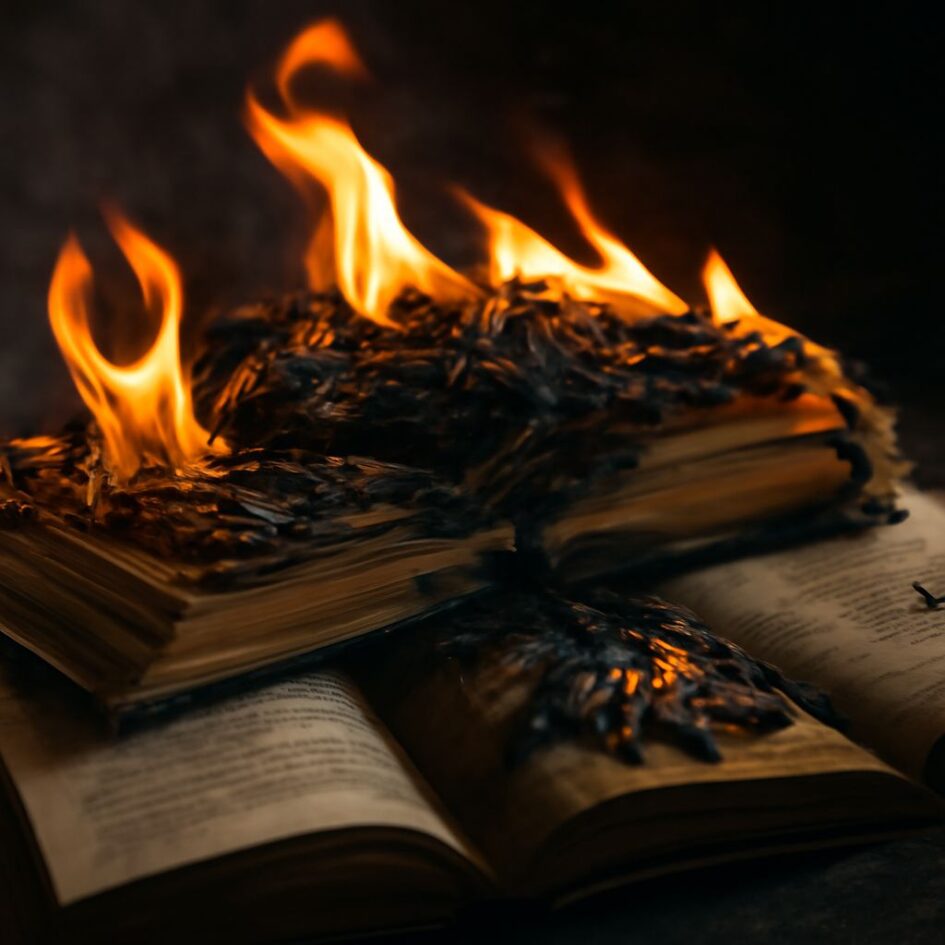
In Fahrenheit 451, burning books is both a public service and an instrument of control. Firemen destroy texts to prevent difficult ideas, disagreement, and independent judgment from entering ordinary life. The practice creates the novel’s central conflict: Montag must decide whether comfort and obedience are worth surrendering knowledge.
The final section, Burning Bright, turns that conflict into direct action. Captain Beatty represents the institution that enforces censorship, while Montag’s escape and the city’s destruction show the consequences of a society that replaces thought with managed entertainment.
What burning books in Fahrenheit 451 represent
Books represent more than information. They preserve contradictory experiences, historical memory, and the ability to examine uncomfortable truths. Their destruction makes society easier to regulate because citizens encounter fewer ideas that might expose injustice or encourage reflection.
The firehouse gives this violence an official appearance. Firemen do not merely suppress forbidden objects; they perform a civic ritual that presents destruction as protection. The burning of a house also demonstrates the state’s power over private life. Montag initially accepts this role, finding pleasure in the sight of flames, but encounters with Clarisse, the old woman, and Faber reveal what the fires erase.
Captain Beatty in Fahrenheit 451: the system’s intellectual defense
Captain Beatty is the fire chief and the system’s most articulate defender. Unlike a simple censor, he understands the books he condemns. He quotes literature, recognizes its complexity, and uses that knowledge to confuse or intimidate Montag. His authority therefore combines institutional power with intellectual performance.
Beatty argues that censorship developed from a public desire for speed, comfort, and social uniformity. Books became threatening because they introduced competing viewpoints and made some readers feel excluded or offended. In his account, the firemen preserve peace by eliminating sources of conflict. This argument shifts responsibility from the government to society, even though the firehouse enforces the final prohibition.
His contradictions reveal the system’s weakness. Beatty knows that books contain insight, yet insists that people are better off without them. He uses language to defend a culture that has become hostile to genuine thought. When Montag resists, Beatty turns the fireman’s authority against him, forcing the conflict toward violence.
What changes in Burning Bright in Fahrenheit 451
In Burning Bright, Montag returns to his own house after Mildred reports him. Beatty orders him to burn it himself, making Montag destroy the domestic life and professional identity he once accepted. When Beatty discovers the earpiece and threatens Faber, Montag kills him with the flamethrower.
Montag then becomes the hunted subject of the same system he served. He escapes through the river, which separates him from the city, and finds Granger and the other book people. They preserve texts by memorizing them rather than possessing physical copies. The city’s bombing soon destroys the old social order, while Montag and the group survive to help rebuild a more thoughtful community.
How the book-burning motif resolves in the novel’s outcome
The novel does not end by treating fire as wholly evil. Its meaning changes. Early fires destroy books, homes, and memory; later, the fire used by Granger’s group provides warmth and companionship. Fire moves from an instrument of institutional control to a shared source of survival.
Montag’s transformation completes the motif. He begins by burning for the state and ends by preserving the ideas that burning was meant to eliminate. Beatty’s death and the city’s destruction show that censorship cannot permanently contain knowledge. The surviving memorized books offer the possibility of renewal after a society built on enforced ignorance collapses.