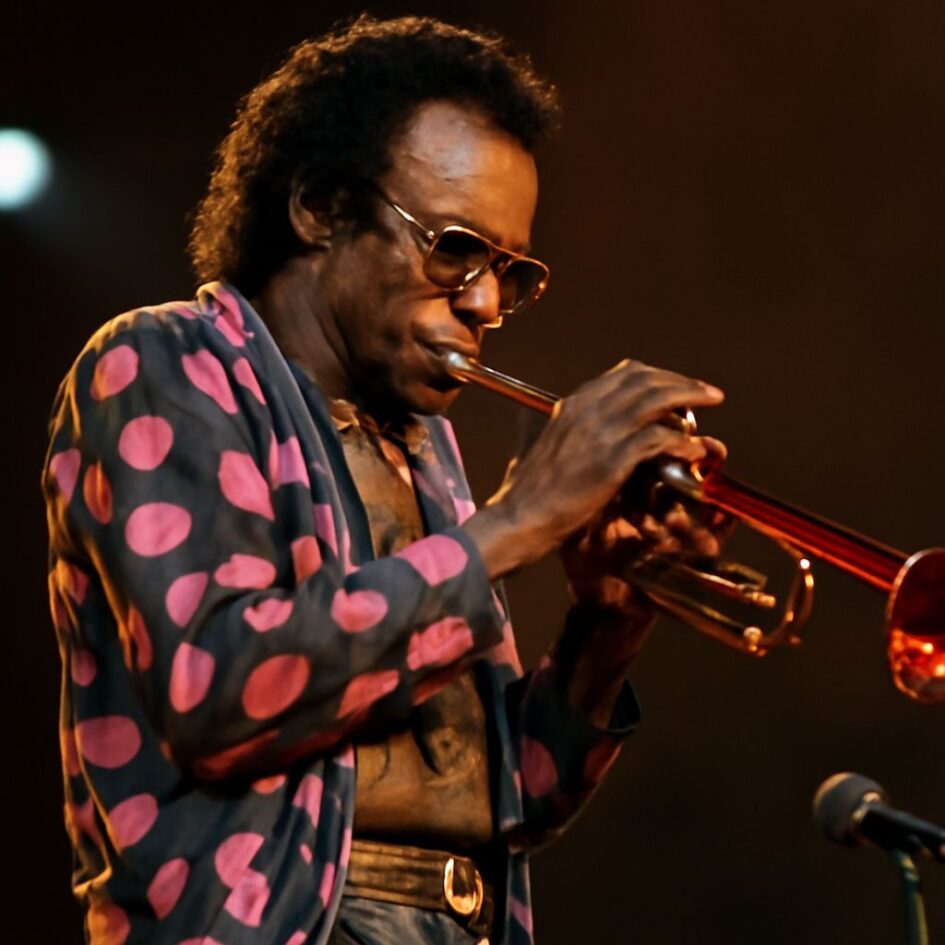
Piano and bass open “So What” before the trumpet enters, leaving space around the notes as important as the notes themselves. Recorded in 1959, the performance introduces a musician who could make a small phrase carry a whole room. The story of who Davis was is also the story of the players who helped him find new ways to make music.
Who Is Miles Davis? A musician in motion
A Miles Davis bio can begin in Alton, Illinois, where he was born on May 26, 1926, and continue through East St. Louis, where he grew up and learned the trumpet. His father was a dentist; his mother was a music teacher. A strong local music scene and early lessons gave him a foundation, but the records reveal the breadth of his later work more clearly than a list of dates alone.
In 1944 he moved to New York, ostensibly to study at the Juilliard School. He also sought out the musicians reshaping jazz on the city’s bandstands. Davis joined saxophonist Charlie Parker’s group and played with other figures associated with bebop, a fast, harmonically adventurous style. His own sound often favored a restrained tone and carefully placed phrases over a continuous rush of notes.
Who is Miles Davis to someone hearing these early sides today? He is a young player learning in public among formidable colleagues, finding an approach that could stand beside Parker’s quick lines without copying them. That balance between listening and asserting a distinct voice would remain central to his career.
A different kind of ensemble
In 1949 and 1950, Davis participated in sessions by a nine-piece band whose instrumentation included French horn and tuba alongside saxophones, trumpet, trombone, and rhythm section. The recordings later became known as Birth of the Cool. Their sound was often more blended and arranged than the small-group bebop associated with Parker.
The project was collaborative. Arrangers and composers including Gil Evans, Gerry Mulligan, and John Lewis helped shape the music, and their contributions are part of what the recordings sound like. Calling the result “cool jazz” can help place it in a history of the style, but the label should not obscure the musicians’ individual choices or suggest that one band invented an entire movement.
Davis struggled with heroin addiction during the early 1950s and later overcame it. By the middle of the decade he had formed a celebrated quintet with John Coltrane, Red Garland, Paul Chambers, and Philly Joe Jones. Their Prestige recordings, including the music collected on Cookin’, Relaxin’, Workin’, and Steamin’, reveal a band that could stretch a familiar song through subtle shifts in timing, intensity, and space.
Modes, orchestras, and the sound of space
In 1957 Davis and arranger Gil Evans recorded Miles Ahead, pairing the trumpeter with a larger ensemble. They worked together again on Porgy and Bess and Sketches of Spain. Evans’s arrangements are not merely a background for a soloist: their colors, transitions, and textures give Davis’s phrases a setting that changes how each note is heard.
The 1959 album Kind of Blue offered another direction. Instead of relying primarily on a fast sequence of chord changes, much of its music uses modes: scales or tonal frameworks that give players room to develop ideas over longer stretches. On “So What,” pianist Bill Evans and bassist Paul Chambers establish a pattern that leaves room for the horns to answer. Coltrane, Julian “Cannonball” Adderley, Wynton Kelly, and Jimmy Cobb also contribute to the album’s sound.
In Miles Davis, jazz found a bandleader willing to leave space for others. That sentence is still only a starting point: the record works because each musician responds to the others. Listening for Chambers’s bass or the difference between Coltrane’s and Adderley’s solos makes the group’s shared invention audible.
A second quintet and an electric turn
In the mid-1960s, Davis formed another influential quintet with Wayne Shorter on saxophone, Herbie Hancock on piano, Ron Carter on bass, and Tony Williams on drums. Recordings such as E.S.P. (1965) and Miles Smiles (1967) show a band playing with tempo, harmony, and song form. The rhythm section might loosen the expected pulse while the horns continued to carry a melody. The result could feel open and precise at once.
The group’s members also wrote important material. Shorter composed several pieces the band recorded, and Hancock’s harmonic ideas and Williams’s drumming helped create its restless character. Davis chose collaborators who could change the direction of a performance, not simply execute a fixed plan. Hearing this group is one answer to the question of the trumpeter’s significance: his work as a leader made room for other artists to develop their own voices.
By the end of the decade, electric keyboards, amplified instruments, and rock and funk rhythms entered his recordings. In a Silent Way appeared in 1969; Bitches Brew, recorded later that year, was released in 1970. Producer Teo Macero used studio editing to assemble and shape extended performances. These records involved large groups, including keyboardists Joe Zawinul, Chick Corea, and Herbie Hancock, among many others.
The change attracted new listeners and divided critics. Some heard a break with acoustic tradition; others heard another stage in a career built on experimentation. In the history of jazz, Miles Davis remains a useful guide to that debate, provided the musicians and studio work around him remain in view.
Later work and a way to listen
Health problems and exhaustion contributed to Davis’s withdrawal from performing in the mid-1970s. He returned to recording and touring in the 1980s, working with younger musicians and incorporating contemporary popular music into his repertoire. His version of Cyndi Lauper’s “Time After Time,” heard on You’re Under Arrest (1985), shows how a familiar pop melody could become a vehicle for his spare, recognizable phrasing.
Davis died on September 28, 1991. His recordings remain a substantial answer to the question of who the musician was, though no one period tells the whole story. A biography can map the changes; listening makes their scale and texture clearer.
Start with “So What,” then compare it with a track from Miles Smiles and a passage from Bitches Brew. Listen for the roles of the rhythm section, the length of a solo, and the space around the trumpet. The differences reveal a bandleader changing his setting while continuing to listen closely to the people beside him.
Sources: Smithsonian National Museum of African American History and Culture: Miles Davis; Encyclopaedia Britannica: Miles Davis; Library of Congress: Kind of Blue.