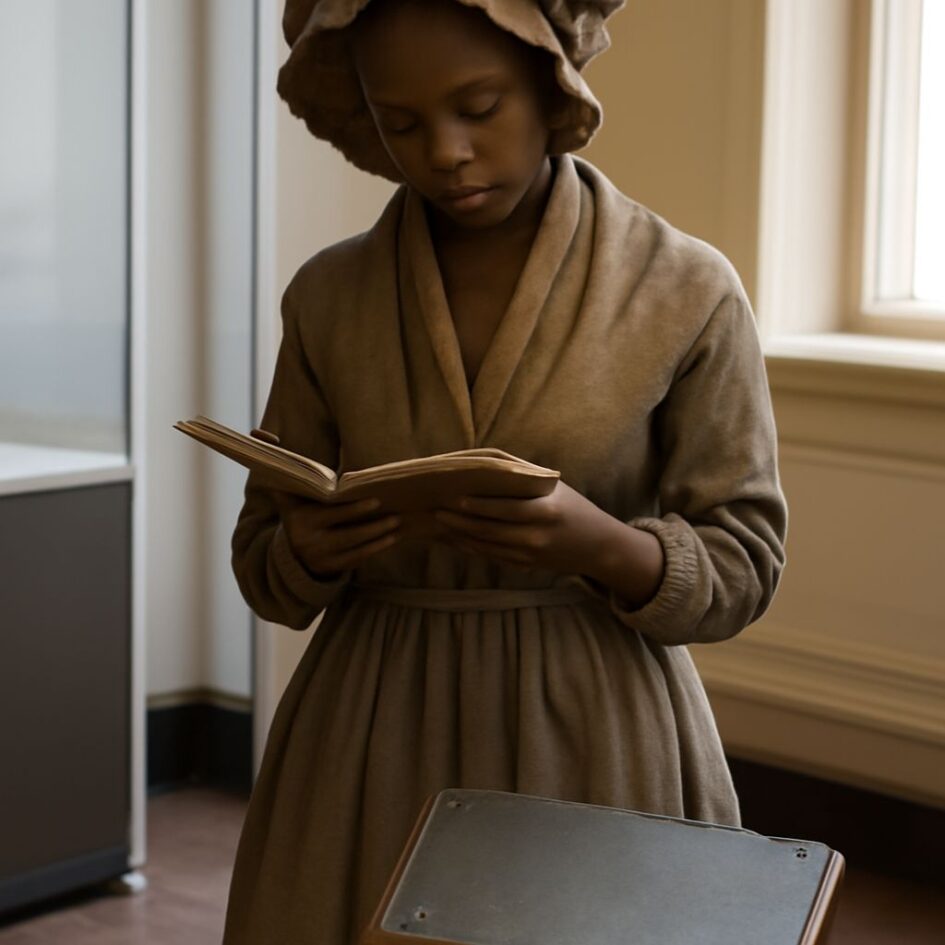
In 1773, a book of poems appeared in London with a portrait of its author at a writing desk and a statement from prominent Bostonians attesting that she had written the work herself. The life of poet Wheatley Peters helps explain why that statement was there: she was an African-born writer enslaved in colonial Massachusetts, publishing in a society that denied Black people equal standing and doubted their intellectual abilities.
Who Was Phillis Wheatley and Why Does Her Work Matter?
Who was Phillis Wheatley? She was a poet, correspondent, and public intellectual who wrote while living under slavery and continued to write after gaining freedom. Her 1773 collection made her the first Black woman to publish a book of poetry in what became the United States. Its publication was an achievement of literary craft as well as an event shaped by unequal access to education, patronage, and the press.
A Phillis Wheatley biography begins with an important limit: her exact birthplace, birth date, and birth name are not known. She was born in West Africa around 1753 and transported across the Atlantic on a ship called the Phillis. In 1761, she was purchased in Boston by John and Susanna Wheatley, whose household gave her the name by which she became known.
The distinction matters because the surviving record is not a complete account of her early life. It was created largely within institutions of slavery and colonial commerce. A missing birth name or a precise village cannot be filled in simply because a biographical story would feel more complete with them.
Education Under Slavery
In the Wheatley household, the young poet learned to read and write and studied the Bible, classical literature, and other subjects. This education gave her tools for a literary career, but it did not change the fact that she was enslaved. Access to books and instruction existed alongside a system that treated her as property.
Her early poems circulated in print before the London collection. An elegy for the evangelist George Whitefield, published in 1770, reached readers on both sides of the Atlantic and helped establish her reputation. An elegy is a poem written in response to a death; in this case, its religious subject connected her to a wide network of readers interested in evangelical Christianity.
The published work also reveals an author who understood the conventions available to her. She used formal verse, classical references, and Christian imagery familiar to educated eighteenth-century audiences. Recognizing those influences does not mean reducing her work to imitation. It means looking at how she used a shared literary language to address subjects that mattered to her and to the world around her.
A Book and the Demand for Proof
Poems on Various Subjects, Religious and Moral was published in London in 1773, with support from British patrons. The volume’s introductory materials included an attestation signed by prominent men who vouched for the author’s ability to write the poems. That document tells readers as much about the prejudices of the audience and the publishing marketplace as it does about the poet.
The attestation should not be confused with proof of a formal courtroom trial. Accounts of a dramatic examination have often been repeated, but the surviving printed statement does not establish every detail of those later versions. The document is most useful when read for what it actually says: influential men publicly certified authorship in a context where a Black woman’s claim to literary authority was routinely challenged.
Phillis Wheatley gained freedom around the time her book appeared, in 1773. Her publication and emancipation were related to the circumstances of her life, but they were not the same event: a printed book did not itself end slavery. The Smithsonian’s description of the volume places the book, portrait, and author within that history.
Reading the Poems and the Letter
One of the best-known poems, “On Being Brought from Africa to America,” brings Christian belief and racial prejudice into a short, difficult text. Its reference to being brought from Africa can be unsettling when read against the violence of forced transportation. The poem also addresses Christians who regard Black people with contempt, insisting that Black people have a place within the religious community.
No single sentence settles the author’s entire view of slavery or of her own displacement. A careful reading attends to the poem’s religious language and its challenge to racist judgment while resisting the temptation to turn it into either a simple endorsement of slavery or a complete statement of resistance.
Another poem, “To the Right Honourable William, Earl of Dartmouth,” connects an appeal for liberty with the experience of being taken from Africa. Its public address is significant: a Black woman writer speaks to a powerful British official about freedom while colonial arguments over political rights are gaining force. The poem places the suffering of enslaved people within that wider discussion.
A 1774 letter to the Mohegan minister Samson Occom makes the contradiction more explicit. Wheatley Peters argues that the love of freedom exists in all people and questions the compatibility of Americans’ demands for liberty with their exercise of oppressive power over others. The letter and its historical context let readers examine her argument in prose, in her own public voice.
Later Life and a Record With Gaps
The story of Wheatley Peters continued after the publication that made her famous. She married John Peters, a free Black man, in 1778. They faced financial hardship, and she died in Boston in 1784. Evidence of plans for another volume survives, but no second collection was published during her lifetime.
The biography of Wheatley Peters is often reduced to a short arc from enslavement to literary success and poverty. That sequence contains real events, but it can obscure the work she produced between them and the systems that shaped her choices. It can also encourage readers to treat uncertain details as settled facts. The Boston Public Library’s account offers a useful guide to surviving evidence and open questions.
Understanding who the poet was means reading both her writing and the documents that framed its reception. The life of Phillis Wheatley Peters included enslavement, authorship, emancipation, marriage, and continued literary ambition; none of those facts alone describes the whole person. Her work gives readers a voice that cannot be replaced by a certificate signed by someone else.
To begin, read her poems through the Poetry Foundation, then consult the Smithsonian’s edition record and the 1774 letter for the historical documents surrounding their publication and reception.