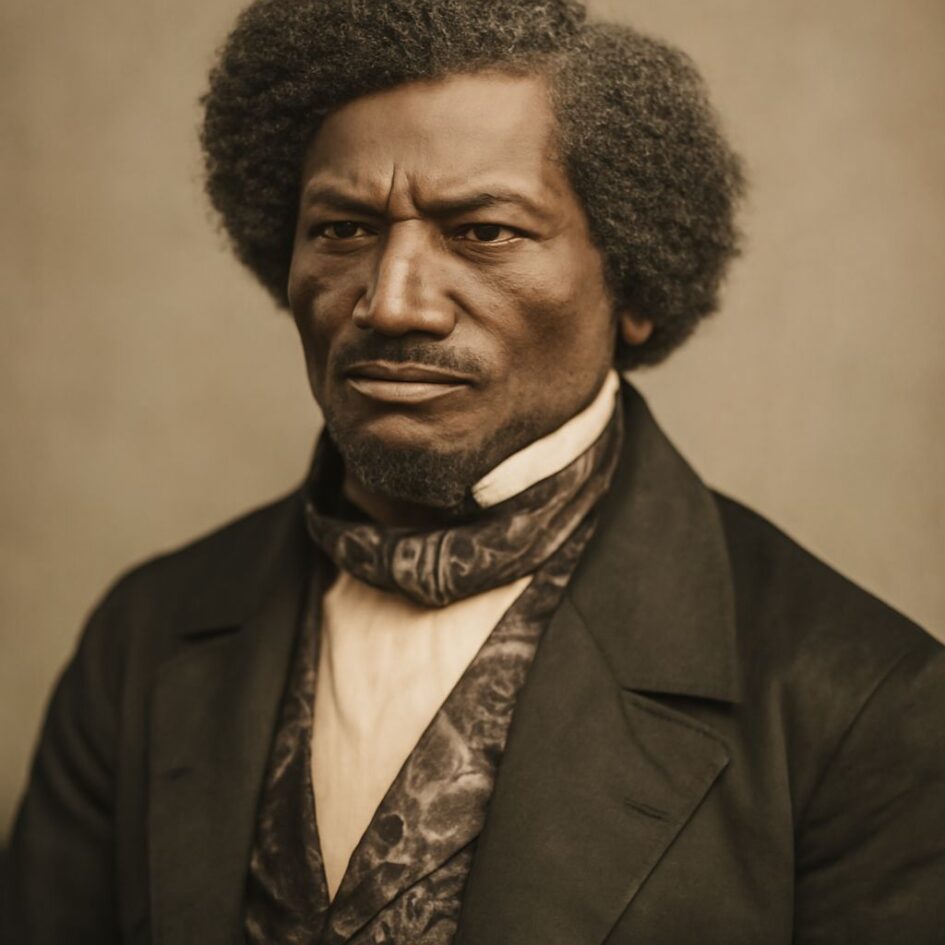
What does it mean to remember an abolitionist whose work remains unfinished? In his poem about Frederick Douglass, Robert Hayden answers with a demanding image: the most meaningful tribute is a freedom shared in everyday life. The poem looks toward a future in which remembrance is measured by what people make possible for one another.
Frederick Douglass by Robert Hayden: A Poem With a Future Tense
Frederick Douglass by Robert Hayden is a poem of commemoration, but it does not begin by listing the subject’s achievements. It begins with a condition: when freedom truly belongs to everyone, Douglass will be remembered in a way worthy of his struggle. That opening moves the reader beyond the familiar image of a heroic figure standing alone.
Hayden’s poem about Frederick Douglass appeared in The Atlantic Monthly in 1947 and was later included in A Ballad of Remembrance, published in 1962. The Academy of American Poets discusses the poem’s publication history and the collection. Its argument acquired particular resonance during the civil rights movement, when the distance between legal promises and lived equality was being publicly contested.
The later context should not be mistaken for the poem’s sole subject. Hayden was writing after the abolition of slavery but long before racial discrimination had disappeared. His future tense allows readers to hear both a belief in freedom and an acknowledgment that its promise is incomplete.
The Historical Figure and the Poet
Douglass was born enslaved in Maryland, escaped in 1838, and became an abolitionist, author, newspaper publisher, and advocate for equal rights. His speeches and writing challenged slavery and later addressed the meaning of citizenship in the United States. His public life matters to the poem even though Hayden does not turn it into a chronological biography.
In the work of Robert Hayden, Frederick Douglass becomes a figure through whom the speaker can test the meaning of public memory. The poem is Hayden’s interpretation, written decades after Douglass’s death in 1895. It is not a speech delivered by Douglass or a transcript of his views.
The distinction also applies to Douglass’s 1845 memoir, Narrative of the Life of Frederick Douglass, an American Slave. That book tells his story in his own voice and serves a different purpose from a poet’s tribute. Reading the memoir alongside Hayden’s Frederick Douglass poem brings together a firsthand account of enslavement and a later meditation on the freedom for which its author fought.
Neither text makes the other unnecessary. The memoir provides experiences and arguments that the short poem does not have room to recount; the poem asks how later generations might honor that history. A biography supplies additional dates and context. Keeping the three forms apart makes their conversation more rewarding.
Freedom as a Daily Necessity
The Poetry Foundation’s text, drawn from Collected Poems of Robert Hayden, supplies the version used here. Early in that text, Hayden calls liberty “this beautiful and terrible thing.” The pairing refuses a simple celebration: freedom is desirable, but its achievement and defense can involve conflict, risk, and responsibility.
Hayden then compares liberty to something “needful to man as air.” Air is not a luxury reserved for a select group; it is necessary to life. The comparison makes freedom feel immediate and practical rather than remote or ceremonial. The poem’s historical language also reflects its time, while the claim it makes reaches toward a shared human need.
For Robert Hayden, Frederick Douglass stands for a vision larger than any single monument. The speaker imagines liberty becoming ordinary enough to be used and shared, yet valuable enough to demand care. That combination gives the poem its tension: a just condition should be natural to live in, but it does not arrive automatically.
Hayden’s poem on Douglass returns repeatedly to the future. Its conditional phrasing is hopeful without pretending the condition has already been met. That distinction matters: praising freedom as an abstract ideal is easier than examining whether people can actually exercise it in schools, workplaces, courts, and public life. Those examples extend the poem’s question into contemporary life; they are not a list supplied by the poem itself.
What the Poem Does With Memorials
The Frederick Douglass poem weighs familiar public tributes against a more demanding form of remembrance. The speaker mentions statues, legends, and poems, then turns toward a living community. These objects can preserve a name and invite inquiry, but the poem argues that they are insufficient as the fullest expression of Douglass’s legacy.
That argument should not be flattened into a claim that every monument is worthless. A statue or a book can help a person learn about the past; neither guarantees that the values associated with its subject are practiced. The contrast is between honoring a figure through representation and making the conditions of freedom more real.
In Frederick Douglass by Robert Hayden, the imagined community is not a passive audience applauding a great individual. People participate in the future the speaker describes. The shift from a single historical figure to collective action helps explain why the poem remains an effective commemorative work: it gives readers something to consider about their own obligations.
The poem by Hayden about Douglass also makes remembrance a question of access. Who can make choices without coercion? Who can participate in civic life? Who has the protection of rights in practice as well as on paper? The poem does not offer a policy program, but its insistence that liberty belong to all gives those questions a clear ethical frame.
Reading the Poem Alongside History
A reader approaching Hayden’s tribute to Douglass can begin with its movement from expectation to remembrance. Notice how the long opening builds a picture of freedom before the poem names the form its tribute will take. Then compare the imagined future with Douglass’s own account of the barriers he faced. The difference between a memoir and a poem is not a defect in either; each makes a different kind of knowledge available.
For a fuller historical account, the National Park Service biography places Douglass’s writing and activism in the context of his life. The poem’s closing vision asks readers to carry that history forward. Its true memorial is not simply an image of Douglass preserved for admiration, but a community making the freedom he pursued part of ordinary life.