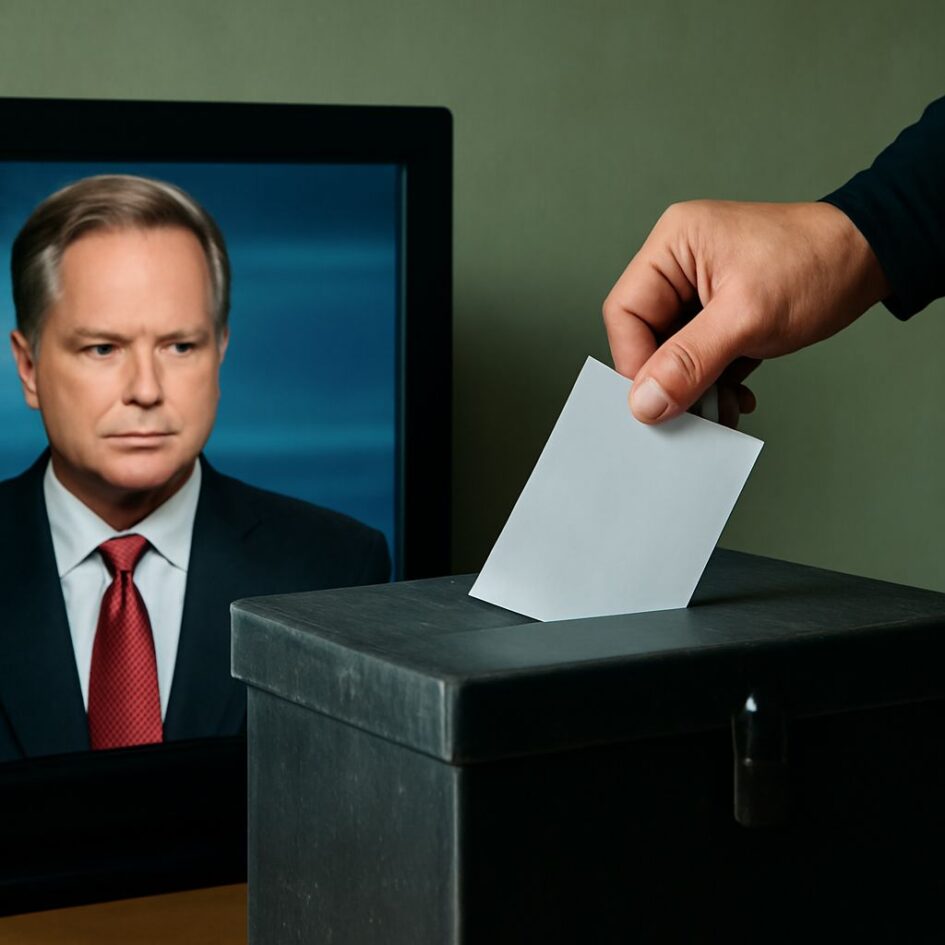
The idea that a secret committee dictates every headline is a poor description of the argument in Manufacturing Consent. Edward S. Herman and Noam Chomsky instead ask how ordinary pressures on commercial news organizations can shape the range of stories that reach the public. Their account of how consent is manufactured examines institutions and incentives, even when no one issues an explicit order.
The 1988 book Manufacturing Consent: The Political Economy of the Mass Media is a joint work by Edward S. Herman and Noam Chomsky. It proposes a model of U.S. news production and tests its argument through case studies, particularly foreign-policy coverage. The model is influential and disputed: it offers readers sharp questions about power while leaving important questions about how to prove the causes of particular coverage.
Noam Chomsky, Manufacturing Consent, and Edward Herman’s Model
In their account of how public consent is manufactured, Herman and Chomsky argue that major news outlets operate within economic and political structures that favor some sources and interpretations over others. A government agency can supply a steady stream of official statements, for example, while a community facing the effects of a policy may struggle to attract the same routine attention. The result, in the authors’ view, can be a public debate organized around the assumptions of powerful institutions.
A manufacturing consent definition should distinguish this process from a claim that every article is false. Their definition of manufacturing consent centers on patterns in what becomes prominent, whose testimony is treated as authoritative, and which questions are pursued. Facts can appear in the news while their placement or framing makes some consequences easier to overlook.
The phrase has an older history: political writer Walter Lippmann discussed the manufacture of consent decades before the book appeared. Herman and Chomsky gave the production of consent a particular institutional account in Manufacturing Consent. Their original description of the model also acknowledges that mainstream outlets compete and sometimes expose wrongdoing; the authors nevertheless argue that systemic pressures shape their overall output.
The Five Filters
The filters are recurring pressures on news production. They are not a checklist that proves a particular story has been manipulated. In the book’s formulation, the five are:
- Ownership and profit. Large news companies need capital and operate within markets. Owners’ interests and the need to make money can influence institutional priorities, including decisions about investment and expansion.
- Advertising. Advertisers provide income for commercial outlets. A publication dependent on that revenue has reason to value audiences and formats attractive to advertisers, which can affect what it can afford to publish.
- Sourcing. Government offices and large businesses regularly provide statements, documents, and access. These sources are efficient for journalists working to deadlines, but repeated reliance can give officials an advantage in defining a story.
- Flak. Organized complaints, lawsuits, campaigns, and other pressures can impose costs on a newsroom. A well-resourced group may be better positioned than an individual reader to make a complaint consequential.
- Anticommunism. In the 1988 account, Cold War hostility to communism supplied a powerful ideological framework. It could make the actions of U.S. adversaries and allies appear in sharply different lights.
The filters can reinforce one another. An official statement arrives quickly; a reporter uses it under deadline pressure; a powerful organization challenges a competing account. The model suggests that these routines may help produce manufactured consent without requiring a newsroom meeting at which an owner dictates the wording of a story. That is the theory’s structural claim, not evidence that this sequence occurred in every case.
What the Historical Cases Show
Herman and Chomsky’s Manufacturing Consent compares coverage of people it calls “worthy” and “unworthy” victims. One comparison concerns Jerzy Popiełuszko, a Polish priest murdered in 1984, and religious figures killed in Latin America under regimes connected to the United States. Herman and Chomsky argue that the U.S. press gave the Polish case more sustained, indignant attention than comparable victims of allied states. Their publisher’s account of the book identifies the victim comparison as a central case study.
That comparison is meant to expose a difference in news values, not a difference in the value of the victims’ lives. The authors examine measures such as the amount and character of coverage, asking whether a victim’s political usefulness to U.S. officials shaped the attention given to the killing. Their analysis makes a concrete prediction: similar abuses may be reported differently depending on who commits them.
The book also examines elections in El Salvador, Guatemala, and Nicaragua, asking how U.S. media treated votes in friendly and hostile states. In Herman and Chomsky’s analysis, news framing that manufactures public consent can reflect official judgments about legitimacy. A reader assessing the argument should examine the articles compared, the dates, the political circumstances, and the standards used to judge the elections. Differences in access, available evidence, and the events themselves can also affect coverage.
What the Model Cannot Establish Alone
Patterns of coverage matter, but a pattern alone does not reveal the mechanism that produced it. A study showing that official voices dominated reports would be stronger if it also investigated newsroom decisions, source availability, editorial records, and alternative explanations. Otherwise, an observed imbalance can be attributed to a filter without demonstrating that the filter caused it.
Media scholar Colin Sparks, writing sympathetically about the model, argues that it needs a more detailed account of political and economic pressures and the real variety of news and opinion. His 2007 analysis also treats journalists as potential allies of reform rather than simply extensions of institutional power. A later scholarly assessment likewise identifies insufficient evidence connecting the five filters as causal mechanisms to particular content; its abstract is available through Aston University.
There is also a difference between explaining news production and demonstrating audience effects. Even a persuasive account of manufactured consent in news content cannot, by itself, establish what readers believed or why. People encounter competing information, interpret it through their own experience, and sometimes reject a story’s framing. Measuring belief requires evidence about audiences as well as about publications.
Reading the Theory Today
The model of consent manufactured through news focused on major U.S. mass media and the political conditions of the Cold War. Digital platforms introduce additional questions about recommendation systems, subscriptions, creators, and the ways stories circulate. An updated application must show how those arrangements work rather than simply substituting a new technology for an old filter.
Herman and Chomsky’s argument about manufacturing consent remains a practical invitation to compare sources, follow money, and notice whose experiences become news. The strongest use of manufactured consent as an analytical idea is also the most demanding: identify a specific claim, compare the coverage with relevant evidence, and investigate the pressures that could have shaped it. A model becomes more useful when its predictions can be tested against cases that might challenge them. The source is Edward S. Herman and Noam Chomsky, Manufacturing Consent: The Political Economy of the Mass Media (Pantheon, 1988).