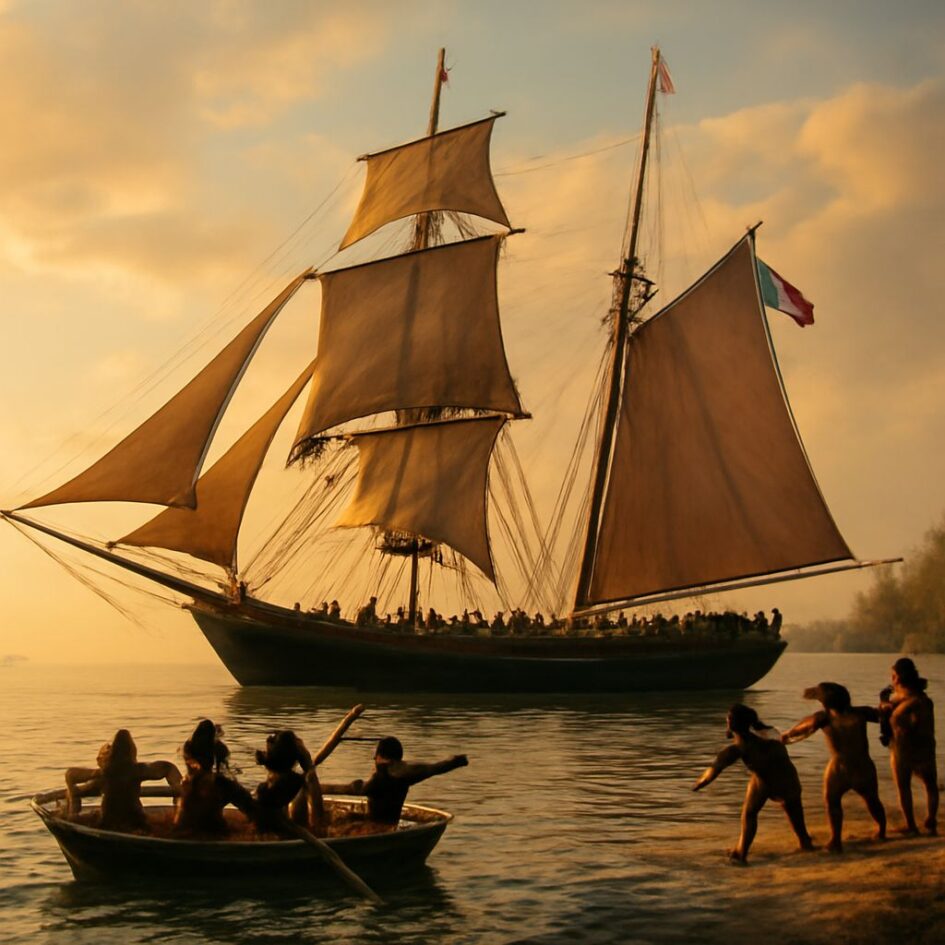
In the summer of 1839, a small schooner left Havana carrying people who had been kidnapped an ocean away. La Amistad’s voyage was meant to take them to another part of Cuba. Instead, the people aboard seized a chance to return home, setting in motion a struggle that reached the highest court in the United States.
Amistad ship: A voyage interrupted
The La Amistad ship was a Spanish-registered coastal schooner, a sailing vessel with two masts. It carried goods as well as 53 African captives purchased in Havana by José Ruiz and Pedro Montes. The buyers intended to transport them to Puerto Príncipe, in what is now Cuba. Their papers described the captives as enslaved people born in Cuba, a claim the ensuing investigation would challenge.
Amistad’s passengers had recently been taken from West Africa and carried across the Atlantic on another vessel, the Portuguese slave ship Tecora. Many came from the region of present-day Sierra Leone. Sengbe Pieh, known in American accounts as Joseph Cinqué, was among them. Their languages, families, and communities did not disappear when traders tried to turn them into cargo.
In early July, Pieh and others freed themselves from their restraints and took control. Amistad’s captain and cook were killed; two members of the crew escaped. The Africans spared Ruiz and Montes, ordering them to sail toward Africa. The two Spaniards instead steered toward the American coast when they could, while maintaining the appearance of an eastward course. Weeks passed at sea, and some of the Africans died. La Amistad’s journey had taken them far from their intended course.
From the shore to a courtroom
In late August, a US naval vessel, the brig Washington, intercepted the schooner near Long Island. Its officers took the vessel to Connecticut. Amistad’s captives were jailed, while the two Spaniards sought to recover them. Murder accusations arising from the revolt were dismissed for lack of jurisdiction; the question of who had a legal claim to the captives remained before the federal courts.
Their arrival brought the captives to a country where slavery was still legal in many states. The case brought several competing claims into a Connecticut courtroom. Ruiz and Montes asserted ownership of the Africans. Officers from the Washington sought a salvage award, payment traditionally claimed for saving a vessel and its cargo at sea. Spain pressed for the return of the captives under a treaty with the United States.
President Martin Van Buren’s administration supported the Spanish position. Northern abolitionists organized a defense, raised money, and sought ways to communicate with the prisoners. Finding interpreters mattered: the Africans could then explain where they had come from and how they had been taken. Their own accounts helped lawyers challenge the documents used to describe them as Cuban-born slaves. The defense had to establish their identities and origins across differences in language, while the captives remained confined during the long legal process.
Amistad’s case drew public attention. The proceedings made the Amistad ship a public issue. Newspapers and campaigners circulated accounts of the revolt and trial, giving readers reasons to debate the slave trade and the meaning of freedom. Those accounts also passed through translators, lawyers, and editors. Court records and the language used by supporters reveal both the Africans’ determination and the ways Americans framed their story for their own audiences.
What the courts decided
In January 1840, a federal district court found that the captives had been taken from Africa illegally and were free. The government appealed. The case reached the US Supreme Court, where former president John Quincy Adams joined attorney Roger Baldwin in arguing for the Africans. Their case depended on the circumstances of these particular people and the unlawful trade that had carried them to Cuba.
On March 9, 1841, the Supreme Court affirmed their freedom. Justice Joseph Story wrote the majority opinion. The Court held that the Africans had been unlawfully kidnapped and had the right to resist their captors. It rejected the Spanish claim that they were property who had to be returned under the treaty. The decision also rejected the lower court’s direction that the federal government return them to Africa under a particular statute; the Africans were to be released.
That distinction matters when reading accounts of La Amistad’s voyage. The ruling freed the people before the Court, but it did not end slavery in the United States. Nor did the decision provide a government-funded passage home. Supporters gathered funds, and in November 1841, 35 survivors sailed from the United States aboard the Gentleman, arriving in Sierra Leone in early 1842. Some chose to take part in a mission established there with American supporters.
For Amistad’s survivors, who had endured the crossing, confinement, and trial, freedom had a practical meaning: the ability to leave custody and make a journey whose destination they could choose. For abolitionists, the case supplied evidence that Africans had fought for their own liberty and that the trade continued despite legal prohibitions.
A replica and a film
The original vessel belongs to the nineteenth-century record. A modern replica named for the original was launched in 2000 as an educational vessel. Amistad’s modern namesake offers a way to discuss maritime life, the revolt, and the long history of slavery, but its construction and later voyages are separate from the events of 1839. An account of the replica’s travels should not be treated as an account of the original schooner.
Steven Spielberg’s 1997 film Amistad brought the story to a large audience through actors, dialogue, and dramatic scenes. A film can make a historical question vivid, but a scene is evidence of the filmmakers’ choices. The National Archives’ account of the case and its discussion of surviving records lead readers toward documents from the proceedings.
The revolt can be traced through those records alongside later interpretations. When a photograph shows a sailing ship, check its date and caption to see whether it depicts the modern replica. When a film supplies a conversation, look for testimony or other contemporary evidence before treating the words as historical fact. The original schooner, the educational replica, and the fictionalized story each carry the past in a different way.