Black Lives Matter art functions as movement communication: it makes a claim visible, gives participants shared language, and carries that language from demonstrations into streets, news images, social media, galleries, and private collections. Posters, signs, murals, graffiti, and short quotations use different visual conditions, but each can turn a political message into a recognizable public statement.
The medium changes how that statement is read. A handheld sign addresses people nearby and moves with a march. A mural occupies a place over time. A poster can be reproduced, photographed, and distributed widely. Repeated phrases create continuity across these formats while local design, location, and authorship keep individual works from becoming interchangeable.
How Black Lives Matter art becomes a visual language
A visual language develops when separate works share words, symbols, colors, layouts, or recognizable forms. In Black Lives Matter expression, the movement name itself often provides the primary structure. Large lettering makes the message legible from a distance, while condensed text, high contrast, and limited color palettes help a design work in both physical and digital settings.
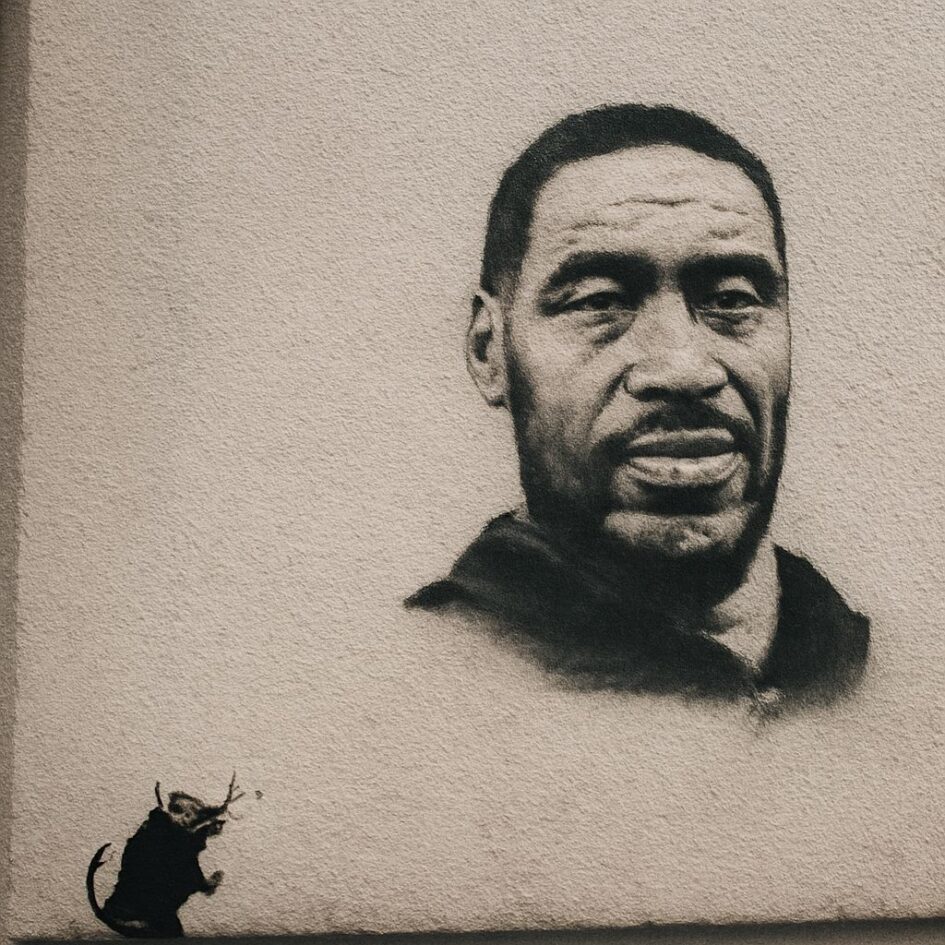
Recurring imagery includes raised fists, portraits, names, linked figures, and references to community, mourning, resistance, and collective action. These elements do not carry one fixed meaning in every setting. A portrait may commemorate a person, assert individuality, or challenge an image of anonymous mass protest. A fist may suggest solidarity, refusal, or historical continuity. Context determines which reading becomes most prominent.
Black Lives Matter artwork also uses scale to establish emphasis. A small print can invite close attention to names or detailed illustration. A large painted wall can make a neighborhood, building, or civic corridor part of the message. Repetition across unrelated locations creates a sense of shared identity, even when artists use different styles and local references.
Black Lives Matter posters and protest signs
Black Lives Matter posters are designed for reproduction and circulation. They may appear on apartment windows, community bulletin boards, storefronts, websites, or social media feeds. Their compact dimensions encourage a clear hierarchy: the movement name or central demand usually receives the largest type, followed by a supporting phrase, date, location, or visual symbol.
Posters can speak beyond the original protest. A photographed poster may circulate without its surrounding crowd, allowing the typography and image to become the main evidence of an event’s message. Digital versions can be downloaded, altered, and redistributed. That flexibility expands reach, but it can also remove local details such as who made the work, where it was displayed, or which issue it addressed.
A protest sign is more immediate and situational. A Black Lives Matter sign held above a crowd identifies the holder with a broad demand, while a sign naming a person, policy, or local event narrows the message. Hand lettering, uneven spacing, and improvised materials may signal urgency and participation rather than a lack of design. Professionally printed signs can provide visual unity across a demonstration.
Reading a Black Lives Matter sign in context
Placement changes the sign’s effect. At the front of a march, it helps establish the demonstration’s public identity. Within a crowd, it contributes to a chorus of messages and may be read quickly by participants. In a photograph, its position relative to faces, police lines, buildings, or media cameras affects the story the image tells. A sign displayed in a home or business becomes a statement of affiliation that remains after the protest has ended.
Text also needs to be read alongside its moment. “Say Their Names” emphasizes remembrance and individual lives; “No Justice, No Peace” connects justice to public stability; “Defund the Police” presents a specific policy demand rather than a general expression of solidarity. These phrases may share a visual field without expressing the same objective.
Murals, Black Lives Matter graffiti, and public space
Black Lives Matter graffiti and murals make location part of the message. Painted words on a wall can address residents, passersby, businesses, officials, and online viewers at once. The surface may be temporary, contested, privately owned, or institutionally commissioned, and each condition affects how the work is understood.
Murals often use scale, color, portraits, and coordinated lettering to create a civic image. A street mural can transform a roadway or wall into a site of collective remembrance. Its visibility may offer recognition to a community, while its permanence can invite debate over who controls public space and which messages receive official protection. Local names, neighborhood references, and artists’ styles prevent every mural from functioning as a generic emblem.
Graffiti tends to emphasize speed, access, and intervention. It may be layered over existing advertisements, architecture, or other writing, making the act of marking a place part of the communication. Its roughness can convey immediacy, anger, or unauthorized speech. A commissioned mural, by contrast, may present a more stable and polished public narrative. Neither form has a single political effect: interpretation depends on the wall, audience, timing, and relationship to the surrounding community.
When Black Lives Matter artwork moves beyond the street
Images of murals and graffiti frequently travel through journalism, social platforms, documentaries, merchandise, and digital archives. Once photographed, a location-based work becomes portable. Viewers far from the original site may encounter the image as a symbol of protest without seeing the local dispute, neighborhood history, or later changes to the wall.
This circulation can preserve work that is painted over or removed, but it can also simplify it. Cropping may exclude surrounding text; reposting may omit the artist; repeated use may detach the design from its original community. Public memory is therefore shaped not only by what was painted, but also by which images were photographed, selected, captioned, and shared.
Black Lives Matter quotes and repeated messages
Black Lives Matter quotes operate as verbal anchors within visual culture. Some are attributed statements by activists, writers, or public figures. Others are slogans that function like quotations because they are repeatedly displayed in quotation marks, posters, murals, and social posts. Their short form makes them easy to read, remember, translate into typography, and attach to images.
Repetition gives language visual power. “Black Lives Matter” asserts value and demands recognition. “Say Their Names” shifts attention toward individual memory. “No Justice, No Peace” uses a compact cause-and-effect structure, while “Protect Black Women” directs attention toward a particular group and concern. Each phrase creates a different frame, even when all appear under the same movement label.
Typography, line breaks, and placement can change how a quotation works. Centered text may resemble a declaration or memorial. Repeated lines can create rhythm across a wall or poster series. A phrase paired with a portrait becomes more specific than the same phrase displayed alone. When these messages recur across signs, murals, news photographs, and online graphics, they become part of the movement’s public memory while retaining different meanings in different settings.